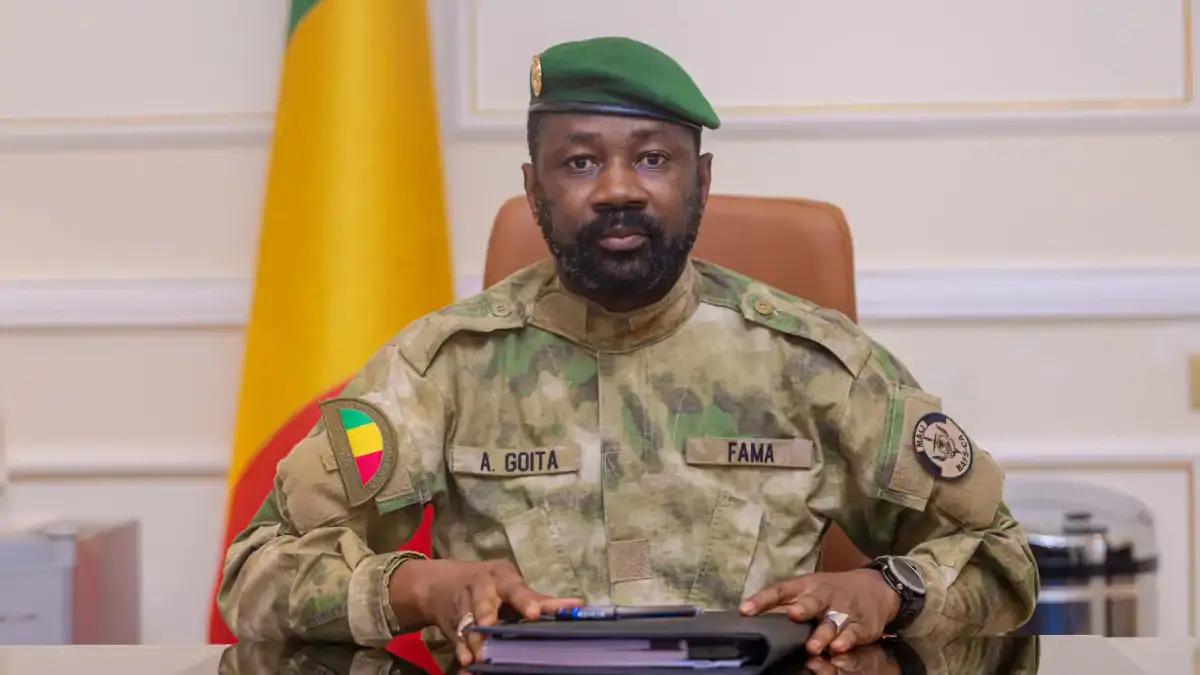
On November 24, 2026, Malian leader Assimi Goïta met with top military officials at Koulouba to discuss strengthening the unified force of the Alliance of Sahel States (AES). Goïta emphasized the need for enhanced regional synergy to tackle security threats. He commended recent progress on the ground and encouraged troops to sustain pressure on armed groups. This development follows a significant military boost on November 16, 2026, when seven aircraft were delivered to the Malian army in Bamako.
The seven aircraft delivered to Mali include one Ilyushin Il-76 transport plane, four Mi-8 maneuver helicopters, and two Mi-24 attack helicopters. These additions are expected to significantly enhance the army's mobility, projection capabilities, and logistical autonomy. The equipment will play a crucial role in supporting the country's security efforts and those of its allies within the AES. The force aims to eventually comprise 15,000 troops, having started with an initial target of 5,000 men in early 2025, later increased to 6,000 soldiers.
The AES unified force was launched in December 2025 by Mali, Burkina Faso, and Niger. The force is a cornerstone of the collective defense strategy of the confederation. During the meeting, discussions focused on internal organization, increasing personnel and equipment numbers, and military programming legislation. Goïta's push for a stronger unified force reflects a broader strategy to bolster regional cooperation and security.
Goïta's meeting with military leaders included Minister Delegate to the Ministry of Defense, General Oumar Diarra, and Chief of the General Staff of the Armed Forces, General Élysée Jean Dao. The emphasis was on reinforcing cooperation among AES countries to solidify their military capabilities. This approach aims to address the complex security challenges in the Sahel region effectively.
The Sahel region has faced significant security threats from armed groups. The AES aims to create a robust defense mechanism through its unified force. By focusing on enhanced cooperation and capabilities, the alliance seeks to improve security outcomes. The progress made and future plans for the unified force are seen as critical steps toward achieving this goal.
The development of the AES unified force and its strengthening are part of a broader regional security strategy. Mali, Burkina Faso, and Niger are working together to create a more stable and secure environment. The involvement of top military leaders and the government's commitment to enhancing military capabilities underscore the importance of this initiative.
As the AES continues to evolve, its impact on regional security will be closely watched. The alliance's efforts to enhance its military capabilities and foster greater cooperation among member states are key to addressing the complex challenges in the Sahel region. The push for a stronger unified force is a significant aspect of this endeavor.
Key points
- Strengthening the AES unified force is crucial for regional security.
- The force aims to comprise 15,000 troops.
- Recent military equipment deliveries will enhance Mali's security capabilities.
Reporting sources
- AES : après la livraison de 7 aéronefs aux FAMA, Goïta se tourne vers la force unifiée · La Nouvelle Tribune