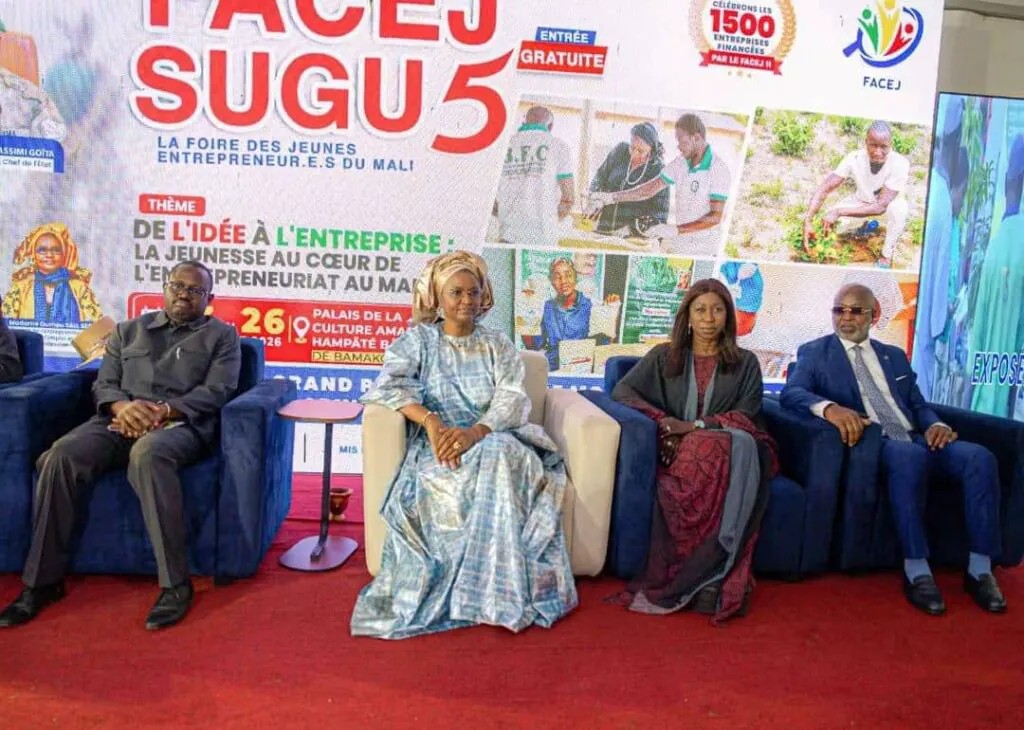
The fifth edition of FACEJ Sugu kicked off on September 23 in Bamako, bringing together 150 young entrepreneurs who are showcasing their products and services. The event, which will run until September 26, aims to bridge the gap between young entrepreneurs and financing, markets, and partners. The Palais de la Culture Amadou Hampâté Bâ has been transformed into a platform for young entrepreneurship, with exhibitors presenting their offerings in various sectors, including agri-food, cosmetics, fashion, and eco-friendly solutions.
According to the FACEJ program's coordination, 1,453 enterprises have been financed as of September 15, 2026, with nearly 3 billion CFA francs in funding. This represents about 97% of the target of 1,500 enterprises set for the second phase. The program has also provided training to 2,174 young people in entrepreneurship and management, while 1,536 business plans have been validated by selection committees. Additionally, over 822 million CFA francs have been reimbursed to 351 young entrepreneurs who have correctly repaid their credits.
The program's focus on women's entrepreneurship and eco-friendly activities is evident, with 574 enterprises led by women receiving 1.9 billion CFA francs in funding, representing about 39.5% of all financed enterprises. Furthermore, 267 young entrepreneurs with green or verdant projects have benefited from financing totaling 1.3 billion CFA francs. The program has also trained 80 young people in agricultural innovation and 21 in solar installations, while 52 others have been supported in designing green solutions.
Christine Kaboré Kayitesi, head of the FACEJ II mission, emphasized that the crucial step is no longer just financing young entrepreneurs but helping them transform their projects into sustainable enterprises. She noted that behind each enterprise exhibited is a "path strewn with obstacles" but also the capacity to "stand tall, reinvent oneself, and pursue efforts." Erik de Feijter, the Dutch ambassador to Mali, highlighted access to credit as a major obstacle to youth entrepreneurship, citing the FACEJ program as a response to this challenge.
The second phase of FACEJ prioritizes women's entrepreneurship and eco-friendly activities, with a focus on strengthening activities related to ecological transition. The program's goal is to create a productive, innovative, responsible, and value-creating entrepreneurship, according to Oumou Sall Seck, Minister of National Entrepreneurship, Employment, and Professional Training. She encouraged exhibitors to use the four-day event to seek clients, partners, and new markets, emphasizing that the real success of such an initiative lies in the relationships created, markets concluded, and enterprises strengthened.
The event provides an opportunity for young entrepreneurs to network with institutions, financial organizations, and chambers of commerce, with the aim of converting contacts into contracts, financing, and market access. The program is supported by five partner institutions, including the National Agricultural Development Bank, Bank of Africa-Mali, and Coris Bank International Mali. The dimension of territorial representation is also significant, with enterprises present from various regions, including Bamako, Kita, Sikasso, and Mopti.
Ultimately, the success of the FACEJ Sugu 5 event will be measured by the lasting impact on the enterprises and entrepreneurs involved, including their ability to secure markets, access credit sustainably, and create jobs. The program aims to enable young people to create their activities, develop their enterprises, and build their future in Mali.
Key points
- The program has financed 1,453 enterprises with nearly 3 billion CFA francs in funding as of September 15, 2026.
- Women's entrepreneurship and eco-friendly activities are prioritized in the second phase of FACEJ.
- The event aims to facilitate access to financing, markets, and partners for young entrepreneurs.