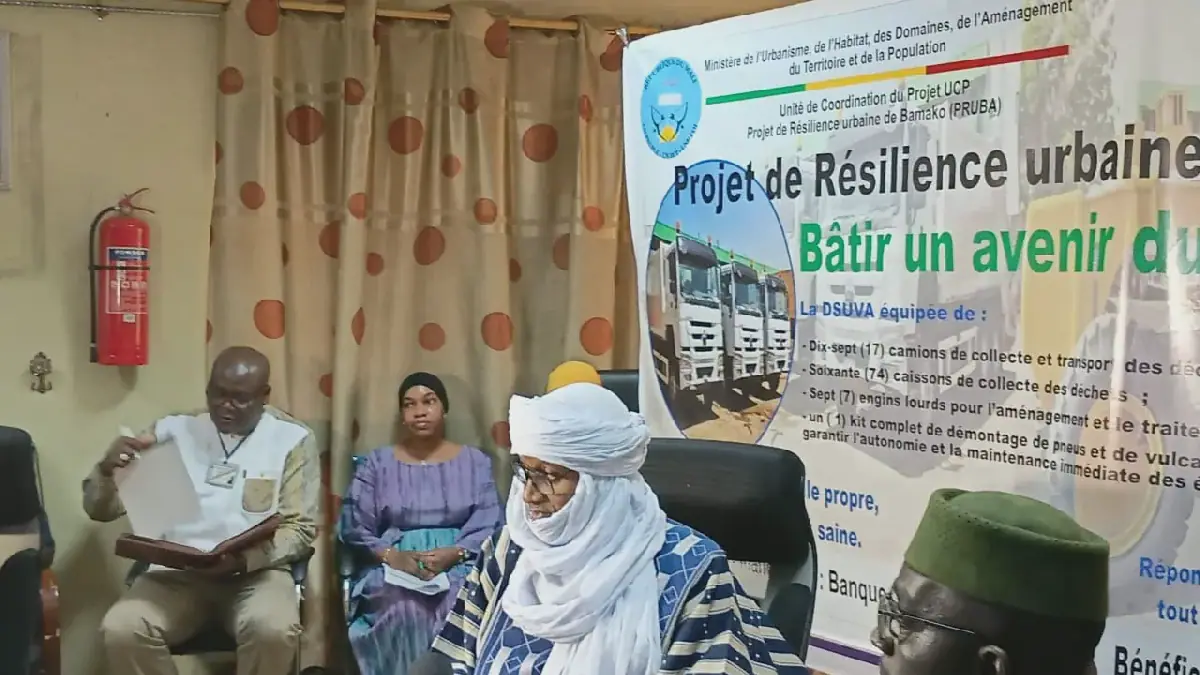
The 6th session of the Bamako Urban Resilience Project (PRUBA) steering committee was held on November 26, 2026, in Bamako, Mali. The meeting was chaired by Minister of Urbanism, Housing, Domains, Territorial Planning and Population Imrane Abdoulaye Touré. The session was attended by project administrators and stakeholders. The committee reviewed the project's technical and financial performance in 2026 and discussed the proposed work plan and budget for 2027.
The project's 2027 work plan and budget, also known as the Plan de Travail et de Budget Annuel (PTBA), outlines 171 activities with a total budget of 44.76 billion FCFA. Of this amount, 28.26 billion FCFA is allocated for activities with approved contracts. According to Minister Touré, these figures demonstrate the government's commitment to investing in priority sectors and improving access to basic services for the population.
Minister Touré emphasized that the project is transitioning from a preparatory phase to a phase of concrete and visible implementation on the ground. He expressed gratitude to technical and financial partners, including the World Bank, for their support in the government's efforts to enhance urban resilience in Bamako.
The steering committee session follows a meeting of the project's technical and monitoring committee, which was held on November 12, 2026. The technical committee reviewed the project's progress and provided input for the steering committee's discussion. The project's progress and plans were examined in detail to ensure effective implementation.
The Bamako Urban Resilience Project aims to improve the city's resilience to urban challenges, including flooding, transportation, and sanitation issues. The project is designed to enhance the quality of life for Bamako's residents and promote sustainable urban development. The steering committee's decisions will guide the project's implementation in 2027.
The project's implementation is critical to Mali's urban development, as Bamako continues to face rapid urbanization and related challenges. The government's commitment to investing in urban resilience is seen as a key step towards addressing these challenges and improving the lives of the city's residents.
The next steps for the project will involve implementing the approved work plan and budget for 2027. The steering committee's decisions will be crucial in ensuring the project's success and achieving its objectives. The project's progress will be closely monitored by stakeholders, including the government, project administrators, and technical and financial partners.
Key points
- The Bamako Urban Resilience Project has a budget of 44.76 billion FCFA for 171 activities in 2027.