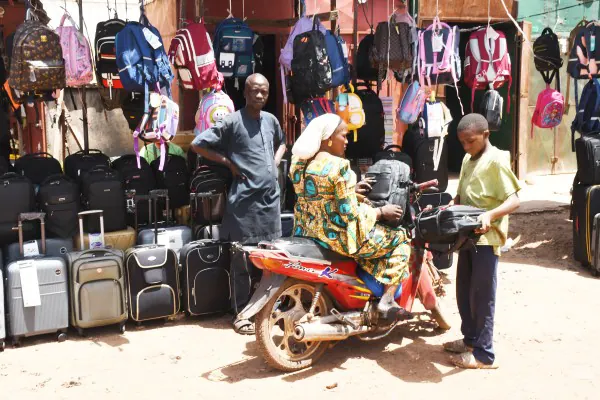
As the new school year begins in Mali, parents are facing a tough time preparing their children's school kits due to financial constraints. At the Dibidani market in Bamako, vendors of school supplies and owners of bookstores and stationery shops are busy, but many parents are finding it hard to afford the necessary items. Lists of required supplies are circulating, and parents are haggling over prices, seeking cheaper alternatives.
Many parents, like Yacouba Boiré, a motorcycle seller at the Dibidani market, have taken on extra financial burdens to ensure their children have the necessary school supplies. Boiré took out a bank loan to buy his children's school kits, highlighting the sacrifices parents are making. Others, like Oumar Guindo, have managed to budget and save to purchase the required items, seeing it as a way to motivate his children to perform well in school.
According to Moussa Samaké, a wholesale merchant at the Dibidani market, the problem lies not with the availability of supplies but with people's purchasing power. He notes that retailers are struggling with liquidity, and customers are buying fewer items, often relying on credit. Samaké believes that the lack of circulating money is affecting not only customers but also retailers, who are finding it challenging to restock.
Vendors agree that the prices of school supplies, particularly notebooks, have increased. Cheick Kéita, a book and school kit seller near the École normale supérieure (ENSUP), reports that the price of a pack of high-quality notebooks has risen to 1,750 Fcfa, while the second quality costs 1,500 Fcfa, a 250 Fcfa increase from last year. However, the price of a pack of pens remains unchanged at 3,500 Fcfa.
The market's sluggishness is evident, with Seydou Keita, a wholesaler, stating that his store is still 70% full in late September, unlike last year when it was almost empty. He made only 150,000 Fcfa in sales the previous day, a significant drop from the nearly one million Fcfa he made during the same period last year. Keita is concerned that if sales do not pick up, he will have to store the unsold stock until September 2027.
Not all vendors share the same concerns, however. Mouctar Diarra, a bookstore owner in the Fleuve neighborhood, cites transportation costs as a significant challenge. He notes that the cost of transporting notebooks has increased from 15,000 Fcfa to over 20,000 Fcfa, affecting his business. While customers still purchase school supplies, they do so less frequently, and many rely on credit, which can be problematic.
As the new school year begins, the reality of financial constraints is evident. While school supplies are available, and parents are eager to purchase them, the lack of disposable income is a significant obstacle. Schools are also preparing for the new year, with cleaning, repairs, and maintenance underway to ensure a safe and welcoming environment for students.
Key points
- The rising cost of school supplies and limited financial resources are major challenges for parents in Mali.
- Vendors report decreased sales and difficulties in restocking due to the financial constraints.
- Some vendors cite transportation costs and decreased purchasing power as significant challenges.