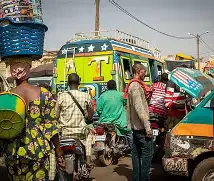
In Bamako, Mali's capital, thousands of commuters rely on Sotrama minibuses for daily transportation. These green vehicles are a familiar sight on the city's streets, ferrying workers, students, and traders to their destinations. However, their age and poor condition are increasingly raising concerns about safety and comfort. The Sotrama, also known as "Caméléon," has been in operation for years, with many vehicles showing signs of wear and tear.
The Sotrama minibuses typically begin their journeys early in the morning, with apprentices often using loud bangs on the vehicle's body to signal departure. As they navigate through the city, they frequently stop to pick up passengers, often with a loud call to indicate another stop. The vehicles' colorful designs and slogans, sometimes provocative or vengeful, are a notable feature. However, their slow pace and frequent stops make journeys lengthy, taking over an hour and a half to cover less than 15 kilometers.
Despite their limitations, Sotrama minibuses remain an essential part of daily life in Bamako. They provide a vital service, especially for those who cannot afford more modern or private transportation. However, their age and condition are taking a toll on passengers, who often endure uncomfortable rides and exposure to smoke emissions. The Malian government has acknowledged the need for modernization, with plans to develop a more efficient and secure transportation system.
In 2016, the Malian government adopted the Politique nationale des transports, des infrastructures de transport et du désenclavement (PNTITD), which aims to establish a multimodal, integrated, efficient, reliable, and secure transportation system by 2035. This vision is also reflected in the Stratégie nationale pour l'émergence et le développement durable (SNEDD) 2024-2033. According to Baboye Dia, director of mobility and facilitation, these plans are crucial for addressing the country's transportation challenges.
Professionals in the sector emphasize the urgent need for renewal of the Sotrama fleet. Souleymane Diallo, secretary-general of the Coordination nationale des syndicats et associations des chauffeurs et conducteurs routiers du Mali, notes that recent discussions have taken place to address the issue. The goal is to create a more modern and efficient transportation system that can accommodate the growing needs of Bamako's population.
As Bamako continues to grow, its transportation needs are becoming increasingly complex. The city's population is expanding, and the demand for efficient and reliable transportation is rising. The Malian government faces significant challenges in modernizing the Sotrama fleet and developing a more comprehensive transportation system. However, with the adoption of strategic plans and ongoing discussions with sector professionals, there is hope for improvement.
The renewal of the Sotrama fleet and the development of a modern transportation system are critical for Bamako's future. With a more efficient and secure transportation network, thousands of commuters can enjoy safer and more comfortable journeys. As the city continues to evolve, it is essential that its transportation infrastructure keeps pace, providing a vital lifeline for the growing population.
Key points
- The Malian government aims to establish a modern and efficient transportation system by 2035.
- The Sotrama minibuses, while essential, are aging and in poor condition, highlighting the need for renewal.
- Professionals in the sector emphasize the urgent need for renewal of the Sotrama fleet to improve safety and comfort.