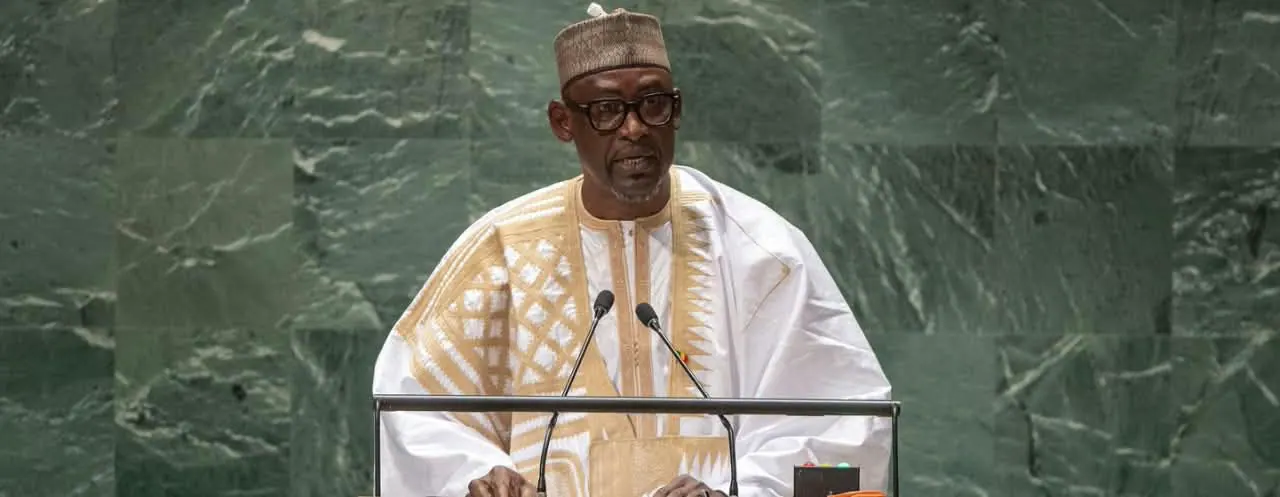
On September 28, 2026, Mali's Foreign Minister and Minister of International Cooperation, Abdoulaye Diop, delivered a powerful speech at the 81st session of the United Nations General Assembly. Speaking on behalf of Mali's Transitional President, General Assimi Goïta, Diop lambasted the current international order, calling it obsolete. He emphasized that Mali and the Sahel region will no longer submit to external pressures.
Diop's speech was marked by a strong attack on Ukraine, which he accused of providing clear and assumed support to terrorist groups operating in the Sahel. He described this as a "hybrid war by proxy." According to Diop, Ukraine is only the visible part of a larger destabilization effort orchestrated by powers nostalgic for colonial times.
The Malian minister criticized the international community's "culpable silence" in the face of these interferences, highlighting double standards and selective application of international law. He argued that the era of interference and the law of the strongest is over. Instead, Mali is committed to forging a new sub-regional order through the Confederation of Sahel States (AES), which includes Mali, Burkina Faso, and Niger.
The AES aims to promote cooperation and solidarity among its member states, allowing them to take control of their destiny. Diop sent a clear message to foreign powers, stating that Mali will not receive instructions from anyone. He emphasized that Sahélian sovereignty is an absolute red line that is non-negotiable. This new geopolitical approach is accompanied by an ideological revolution in economic matters.
Diop made a striking statement about international aid, saying that it has never developed a country, despite being useful. Mali is now focusing on its natural resources, such as gold and lithium, and its youth to drive development. The country is opting for internal wealth generation and refusing "aviliating" financing with political conditionalities, aiming for total strategic autonomy.
In conclusion, Diop called for a "refoundation" of the United Nations, advocating for a multipolar world without hegemony, where Africa is treated as an equal power. He emphasized that Africa should no longer be a playground for external powers but a pole of power in its own right. This statement confirms Mali's strategic shift, positioning it as a spearhead for a de-complexed Africa.
Diop's speech reflects a significant change in Mali's international stance, with the country seeking to assert its sovereignty and independence. The international community is likely to take note of Mali's new approach, which could have implications for global politics and international relations. Mali's commitment to self-determination and strategic autonomy is clear.
Key points
- Mali's Foreign Minister Abdoulaye Diop calls for a refoundation of the United Nations.
- Diop criticizes international community's double standards and selective application of international law.
- Mali is focusing on its natural resources and youth to drive development and achieve strategic autonomy.