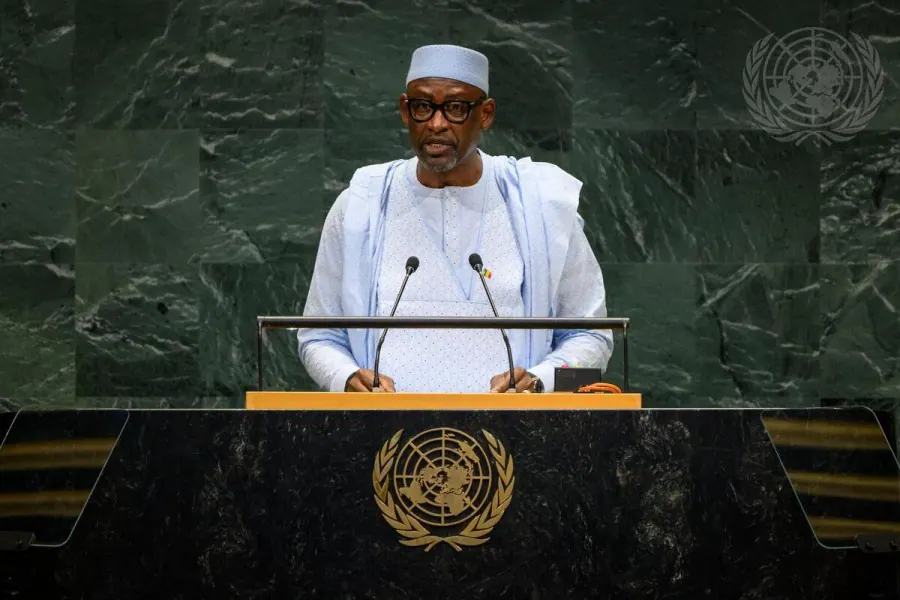
On September 28, 2026, Mali's Foreign Minister Abdoulaye Diop addressed the 81st United Nations General Assembly, delivering a speech that went beyond diplomatic courtesies. Diop's address was a structured indictment of the current multilateral order and a presentation of Mali's foreign policy doctrine, emphasizing sovereignty, diversification of alliances, and strategic autonomy for the Sahel region. He noted that Mali was admitted to the UN on September 28, 1960, just six days after gaining independence.
Diop's speech was themed around "Restoring Trust, Accompanying Transformations," which provided a framework for him to transform a defensive address into an accusation. He listed causes of the crisis of trust in international institutions, including flagrant violations of international law, selective application, and the use of force. The minister concluded that citizens worldwide have lost faith in institutions, particularly the UN. He emphasized that the problem is not just about denouncing acts but also about addressing the architecture of the international system.
Diop directly accused Ukraine of supporting terrorist groups in the Sahel, citing Ukrainian statements from 2024 and a public reiteration at a state summit. He mentioned corroborating "independent sources" and criticized the international community and Africa for their "culpable silence." Diop described Ukraine as "the visible part of the iceberg of destabilization" aimed at breaking the will of Sahel countries to emancipate from colonial tutelage.
The minister's speech also highlighted the economic aspect, stating that international aid has never developed a country. He called for generating internal resources and seeking "non-degrading financing" without geopolitical considerations. Diop emphasized the demographic challenge, noting that no amount of aid can absorb the millions of young people entering the workforce in Mali, Burkina Faso, Niger, and Africa.
Diop paid tribute to General Sadio Camara, the late Minister of Defense, whose legacy is presented as a source of inspiration for a generation. He also mentioned national programs, such as Vision Mali Kura 2063 and SNEDD 2024-2033, described as a "pact of generations." These programs focus on local transformation of natural resources and a central role for youth.
The minister concluded by calling not just for reform but for a "refounded" UN that is more just, representative, and truly serving all peoples. He advocated for strengthening the representativeness of multilateral institutions and making Africa's voice heard in decision-making. Diop explicitly acknowledged the shift towards a multipolar world, emphasizing that it should be based on cooperation, not confrontation or the law of the strongest.
Three main lines structure Diop's speech: a systemic critique of the current international order, a coherent doctrine emphasizing sovereignty, diversification of partnerships, and strategic autonomy, and an open question about whether Mali's autonomy will translate into expanded cooperation or assumed isolation. The response to this question will depend on the actions taken and how the rest of the world receives them.
Key points
- Mali's Foreign Minister Abdoulaye Diop calls for a refounding of the UN.
- Diop criticizes the current international order and emphasizes Mali's sovereignty.
- The minister advocates for strategic autonomy and cooperation in a multipolar world.