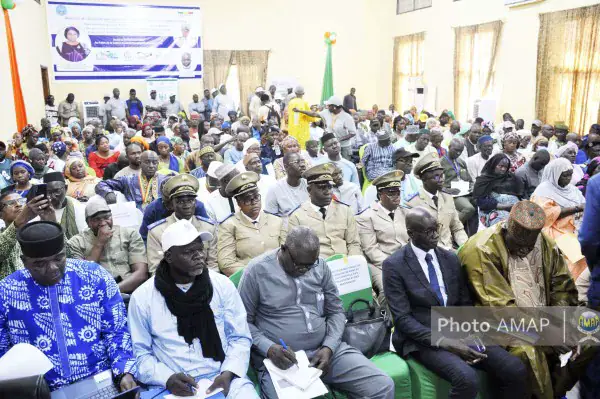
The Malian government has launched a new national sanitation policy aimed at addressing the country's growing environmental challenges. The policy, adopted by decree on April 10, 2026, sets out to provide a strategic framework for improving sanitation services and protecting the environment. The policy's launch was marked by a four-day regional consultation in Bamako, which brought together stakeholders from across the country to discuss the implementation of the policy.
The consultation, organized by the Direction régionale de l'assainissement, du contrôle des pollutions et des nuisances du District de Bamako (DRACPN), aimed to strengthen dialogue and cooperation among stakeholders in the sanitation sector. The event was attended by representatives from the Ministry of Environment, Urban Planning, and Climate Change, as well as local authorities, traditional leaders, and technical and financial partners. The representative of the Minister of Environment, Sékou Koné, emphasized that sanitation is no longer just a matter of public health, but also a critical component of human dignity, environmental security, and economic development.
The new national sanitation policy is aligned with Mali's Constitution, Vision Mali Kura 2063, and the National Strategy for Emergence and Sustainable Development (SNEDD 2024-2033). The policy sets out to achieve universal access to sustainable sanitation services by 2045. According to Sékou Koné, the policy's success will depend on effective coordination, financing, and maintenance, as well as the involvement of all stakeholders. He stressed that the policy must be translated into concrete actions and investments on the ground.
The representative of technical and financial partners, Issa Sissoko, emphasized the importance of effective coordination and institutional strengthening to ensure the sustainability of investments in the sanitation sector. He reaffirmed the support of partners, including the World Bank and the German Development Cooperation (GIZ), for the implementation of the policy. However, he warned that the durability of investments must be considered from the outset, rather than at the end of the project.
The Governor of Bamako District, Abdoulaye Coulibaly, stressed that sanitation is a collective responsibility and that no single institution can address the complex challenges of urban sanitation alone. During the four-day consultation, participants will establish a shared diagnosis, clarify the roles of each actor, and propose realistic solutions. The expected outcomes include strong recommendations, a regional roadmap for 2026-2028, and a permanent monitoring mechanism.
The new national sanitation policy is part of a broader effort to address the environmental challenges facing Mali. The country has been experiencing rapid urbanization, which has put pressure on sanitation services and infrastructure. The policy aims to address these challenges by promoting a culture of sanitation, improving waste management, and protecting the environment. The implementation of the policy will require the involvement of all stakeholders, including local authorities, communities, and technical and financial partners.
The launch of the new national sanitation policy marks a significant step towards addressing Mali's environmental challenges. The policy's success will depend on effective coordination, financing, and maintenance, as well as the involvement of all stakeholders. With the support of technical and financial partners, the Malian government is committed to implementing the policy and achieving universal access to sustainable sanitation services by 2045.
Key points
- The Malian government has launched a new national sanitation policy to address the country's growing environmental challenges, including waste management and pollution.