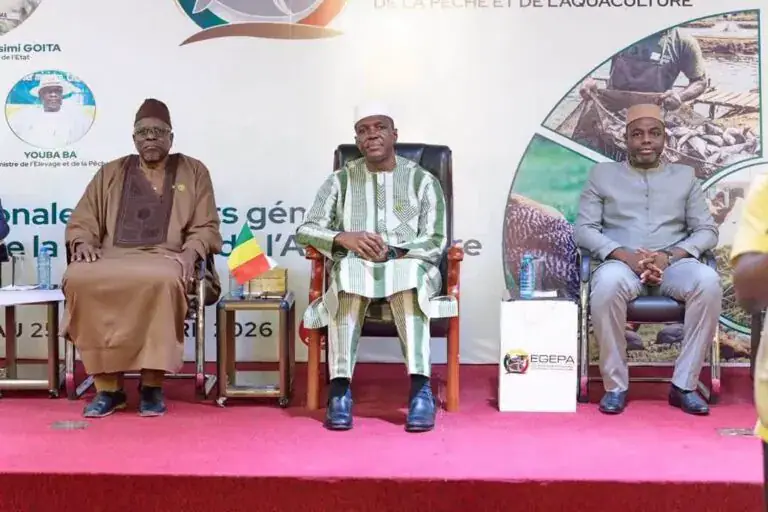
The Malian government launched the National Livestock, Fisheries, and Aquaculture Conference (EGEPA) on November 23, 2026, in Bamako. The conference was presided over by Prime Minister Abdoulaye Maïga, representing the head of state, General Assimi Goïta. The event brought together government officials, professional organizations, technical partners like the FAO, and delegations from Burkina Faso, Niger, and Guinea. The conference focused on modernizing animal, fish, and aquaculture industries to ensure food security and nutrition.
The conference theme, "Modernizing animal, fish, and aquaculture industries in Mali to guarantee food security and nutrition," guided the discussions. The event followed preparatory consultations that began on July 7, 2026, with the installation of the national organization commission led by Modibo Traoré. According to Drissa Coulibaly, assistant technical, contributions came from actors in six agro-ecological zones of the country. Despite having over 30 million hectares of pastures and a vast hydrographic network, the sector faces infrastructure shortages, low local transformation, climate effects, and security constraints.
The livestock and fisheries sector in Mali has shown significant production levels. The 2025 agricultural campaign recorded 157,775 tons of controlled meat, 122,671 tons of fish, and 17,238 tons of collected milk. For 2026, authorities aim to produce 133,296 tons of fish. Prime Minister Abdoulaye Maïga outlined five key areas of action: improving economic performance, ensuring sustainable resource management, integrating women and youth, strengthening institutional capacities, and developing durable partnerships.
The Malian government recognizes the need to address several challenges in the sector. In July 2026, Minister of Livestock and Fisheries Youba Ba emphasized the importance of improving access to financing, markets, water points, and animal health to sustainably valorize these resources. The sector's modernization is expected to involve various stakeholders, including local communities, to ensure the sustainable management of natural resources.
The conference also highlighted the potential for regional cooperation and knowledge sharing. The presence of delegations from neighboring countries like Burkina Faso, Niger, and Guinea underscores the region's interest in collaborating on sustainable livestock and fisheries management. This cooperation can facilitate the exchange of best practices and expertise, ultimately contributing to the sector's growth and development.
The Malian government's efforts to modernize the livestock and fisheries sector align with its broader goals of ensuring food security and promoting economic development. By addressing the sector's challenges and leveraging its potential, Mali aims to increase its production levels and improve the livelihoods of communities dependent on these industries. The conference's outcomes are expected to inform policy decisions and guide future investments in the sector.
As the conference concluded, stakeholders are expected to implement the agreed-upon strategies and actions. The government's commitment to modernizing the livestock and fisheries sector is seen as a crucial step towards achieving sustainable development and food security in Mali. The sector's growth is also expected to have positive impacts on the country's economy and the well-being of its population.
Key points
- The conference aimed to modernize Mali's livestock, fisheries, and aquaculture sectors to ensure food security and nutrition.
- The sector faces challenges such as infrastructure shortages, low local transformation, climate effects, and security constraints.
- The government aims to produce 133,296 tons of fish in 2026 and has outlined five key areas of action for the sector's development.