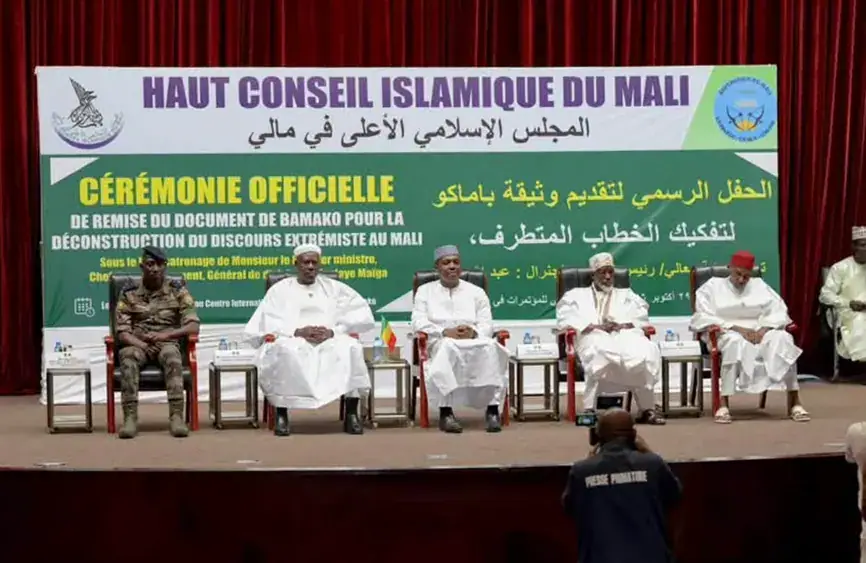
The Malian government has taken a significant step in its fight against violent extremism with the introduction of the "Document de Bamako," a comprehensive plan aimed at preventing radicalization through religious contributions. Submitted to Prime Minister Abdoulaye Maïga on October 29, this initiative is led by the Haut Conseil Islamique and seeks to engage religious leaders in promoting tolerance and social cohesion. The document's content, however, remains undisclosed.
The launch of the Document de Bamako is a culmination of efforts by various stakeholders, including the Union nationale des associations de femmes musulmanes du Mali, who expressed deep concern about the future of Mali's youth. Diakité Kadia Togola, President of the organization, highlighted the need for collective action to address the growing threat of extremism. This sentiment is shared by the government, which recognizes the influential role of religious leaders in shaping public opinion and promoting peaceful coexistence.
One of the key strategies outlined in the Document de Bamako involves the training of Imams, preachers, and other religious figures to promote messages of tolerance and social cohesion. This approach has been tested in various regions, including Bla and Koutiala, where 120 religious actors were trained in preparing guides for sermons and speeches. Aïssata Coumaré, a medersa teacher from Koutiala, noted that the training helped her better understand the concept of social cohesion as advocated by the Quran.
The use of radio stations as a medium for disseminating messages of peace and tolerance is another critical component of the Document de Bamako. The project PARLER, conducted by the PNUD and Think Peace, has already engaged 27 radio stations in promoting social cohesion and preventing violent extremism. This multi-faceted approach aims to reach a wider audience and create a ripple effect in promoting peaceful values.
The Malian government's efforts to counter violent extremism are also reflected in its policies and legislation. The Constitution, adopted on July 22, 2023, guarantees freedom of conscience, religion, and expression, while the Code pénal of December 13, 2024, criminalizes incitement and apology for terrorism. These measures demonstrate the government's commitment to addressing the root causes of radicalization and promoting a culture of peace.
Despite these efforts, challenges persist, particularly in accessing populations in insecure regions. Dame Seck, chargé de communication au Secrétariat permanent de lutte contre l’extrémisme violent, noted that insecurity hampers the deployment of teams in certain areas, forcing them to rely on media channels to continue their sensitization efforts. The issue of unemployment, perceived injustice, and logics of revenge are also identified as factors contributing to radicalization.
The success of the Document de Bamako depends on effective collaboration between stakeholders, including government agencies, religious organizations, and civil society. With plans for dissemination through meetings, sermons, and conferences, the government's goal is to promote a culture of peace and social cohesion. Key to this endeavor is the involvement of youth organizations, such as the Conseil national de la jeunesse, which has pledged to participate in the document's vulgarization.
Key points
- The Malian government has introduced the Document de Bamako to engage religious leaders in preventing violent extremism.
- The document's strategy includes training Imams and using radio stations to promote messages of tolerance and social cohesion.
- Challenges persist, including insecurity and unemployment, which are being addressed through a comprehensive approach involving government agencies, religious organizations, and civil society.