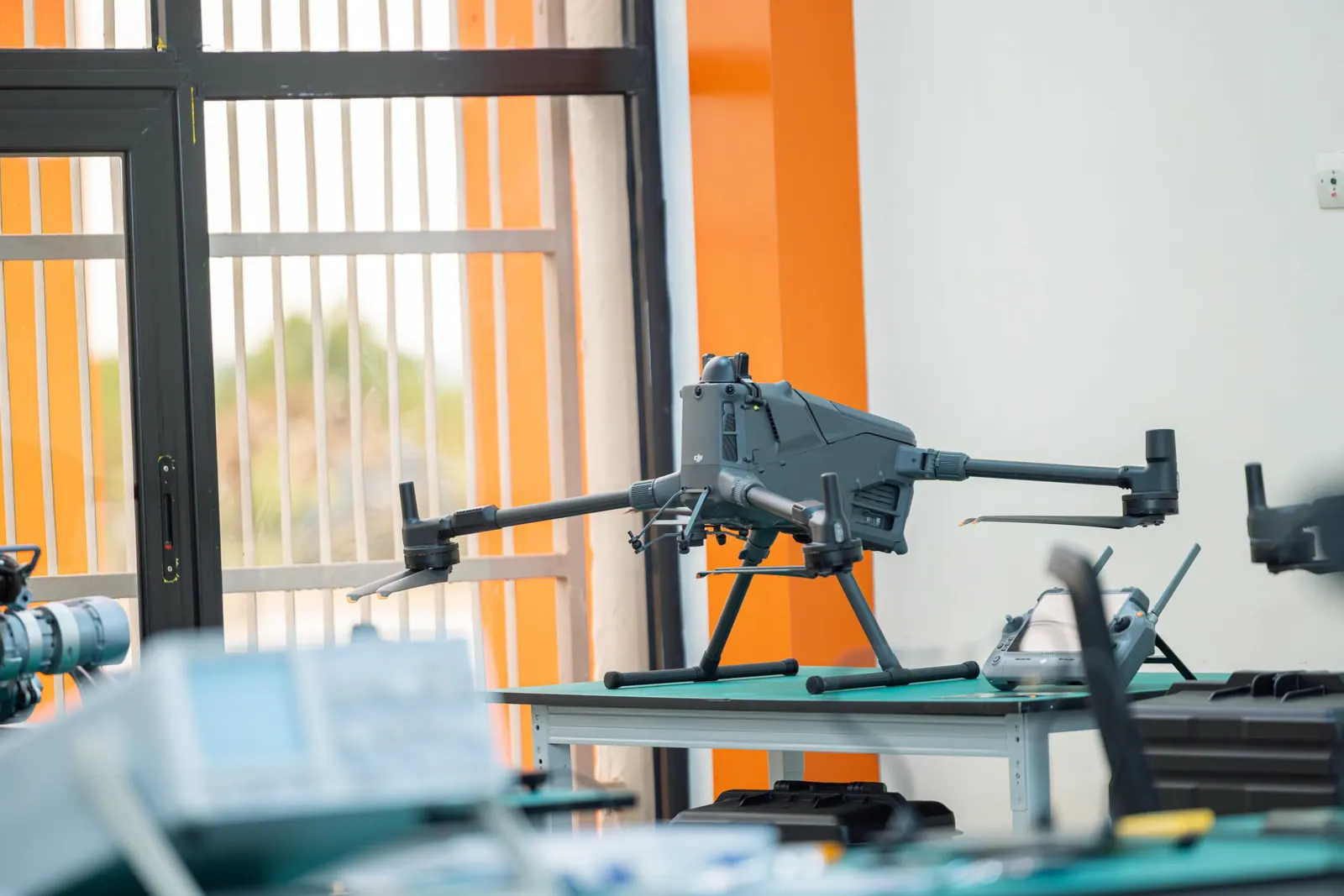
The Malian government has taken a significant step in its scientific strategy with the inauguration of the Centre d'intelligence artificielle et de robotique du Mali (CIAR-Mali) on September 21, 2026. Located in Kati-Sirakoro Niaré, near Bamako, the center aims to train talented individuals capable of designing and developing cutting-edge technologies. The facility, built on a 50-hectare site, was constructed at a cost of 3.3 billion francs CFA, using public resources.
The CIAR-Mali center boasts modern infrastructure, including educational blocks, an auditorium, dormitories, a restaurant, infirmary, sports facilities, and technical spaces dedicated to drones. The construction was carried out by a Malian enterprise, with local artisans responsible for the interior fittings. The center's creation was formalized by an ordinance in August 2023, with a focus on education, research, and development in artificial intelligence, robotics, and engineering sciences.
The center's primary objective is to equip the next generation with the skills to design, build, and export technologies, rather than simply consuming them. According to President Assimi Goïta, "Our children will no longer just consume technology from the world; they will learn to think, build, and export it." The center's curriculum will emphasize mathematics, physics, and engineering sciences, with plans to expand into AI, robotics, data science, and intelligent systems engineering.
The initiative addresses a broader challenge highlighted by the World Bank in 2023, which noted a shortage of training programs adapted to the needs of Mali's digital economy. The CIAR-Mali aims to bridge this skills gap and build on existing initiatives, such as RobotsMali, which promotes robotics and technology among Malian youth. The center's establishment is seen as a crucial step towards achieving technological sovereignty and driving development.
The CIAR-Mali project has been in development since June 7, 2023, when the first stone was laid in Sirakoro Niaré. With its official inauguration, the center is now poised to become a hub for scientific and technological production, training engineers and researchers, and developing solutions tailored to Mali's specific needs. The center's impact will depend on its ability to deliver innovative solutions, create jobs, and make a tangible difference in the country.
As the continent intensifies its pursuit of digital competencies, Mali is positioning itself to create its own pool of skilled professionals. The country's investment in knowledge aims to reduce its technological dependence in the long term. To achieve this, the CIAR-Mali will need to demonstrate its capacity to produce high-quality graduates, drive innovation, and create practical applications that can be scaled up beyond Mali's borders.
The coming years will be crucial in determining the center's success. With a planned intake of 40 students for the 2026-2027 academic year, the CIAR-Mali has set an ambitious agenda. As the center begins its operations, it will face the challenge of translating its vision into tangible results, making a meaningful impact on Mali's technological landscape, and serving as a model for other countries in the region.
Key points
- The CIAR-Mali center aims to train talented individuals in artificial intelligence, robotics, and engineering sciences to drive technological development in Mali.
- The center's establishment addresses a broader challenge highlighted by the World Bank, which noted a shortage of training programs adapted to the needs of Mali's digital economy.
- The CIAR-Mali project has been allocated 3.3 billion francs CFA and spans 50 hectares, featuring modern infrastructure, including educational blocks, an auditorium, and technical spaces.