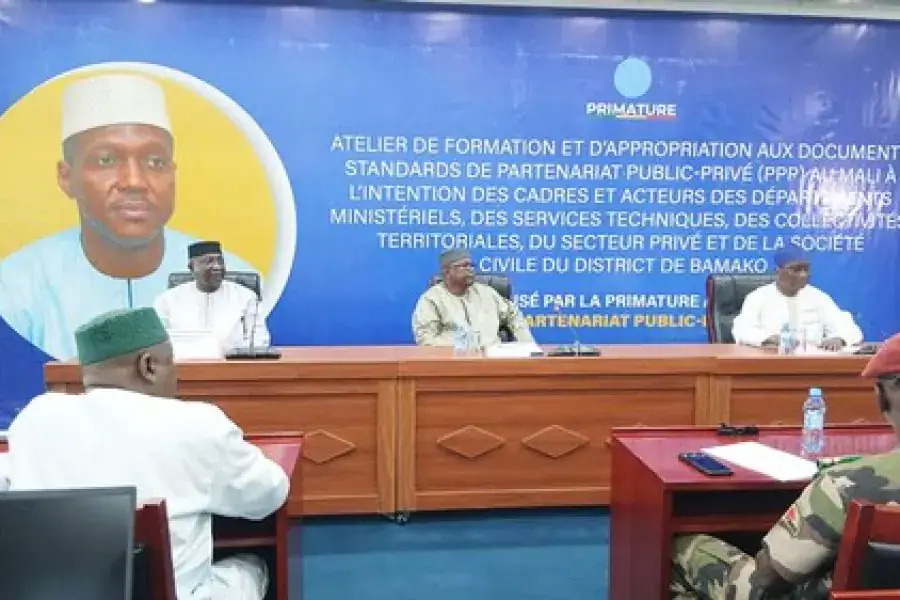
The Centre International de Conférences de Bamako (CICB) is hosting a three-day training workshop on Public-Private Partnerships (PPPs) and the appropriation of standard documents. The workshop, which started on November 3, 2026, was launched under the presidency of the Director of Cabinet of the Prime Minister, Mahamadoun Touré. The event brings together actors from the public, private, and civil society sectors in the Bamako District.
The Malian government has initiated a PPP strategy to address the country's infrastructure deficit and promote quality and durability by leveraging private sector resources and expertise. According to Mahamadoun Touré, the country is committed to achieving economic sovereignty. The PPP strategy aims to mobilize private financing while enabling the state to continue investing in projects that meet the needs of the population.
Mali has significant needs in essential areas such as clean water, energy, transportation, sanitation, agriculture, health, and education. The PPP can be an important instrument for mobilizing private financing while allowing the state to continue investing in projects that meet the needs of the population. Touré emphasized that the success of a PPP requires a good identification of projects, a rigorous prior evaluation, and a balanced distribution of risks.
The Malian government has established a legal framework for PPPs, including Law No. 2016-061 of December 31, 2016, which sets out the legal and institutional framework for PPPs. The law is complemented by two decrees of February 9, 2017, which fix the modalities of application of the law and create the Unité de Promotion des Partenariats Public-Privés (UPPP). However, Touré stressed that the existence of this framework is not enough, and its implementation requires careful planning and execution.
The workshop will focus on four key tools: the methodological guide to PPPs in Mali, standard consultation documents and evaluation reports, a standard PPP contract, and a financial model for PPP projects. These tools were validated during a national workshop held from April 13 to 17, 2026, and approved by the Prime Minister on May 11, 2026. The participants will spend three days learning about the legal and institutional framework of PPPs, reviewing methodological guides, and understanding the steps for preparing and implementing contracts.
The Coordinator of the UPPP, Issa Hassimi Diallo, welcomed the participants and presented the standard documents that will be used during the workshop. The documents are designed to facilitate the preparation and implementation of PPP projects in Mali. The workshop aims to enhance the capacity of participants to implement PPP projects effectively and ensure that they are aligned with the country's development needs.
The training workshop is expected to equip participants with the knowledge and skills needed to implement PPP projects in Mali. The event is a significant step towards enhancing the country's capacity to develop and implement PPP projects, which are critical to addressing the country's infrastructure deficit and promoting economic growth.
Key points
- The Malian government has established a PPP strategy to address the country's infrastructure deficit and promote quality and durability by leveraging private sector resources and expertise.
- The country has significant needs in essential areas such as clean water, energy, transportation, sanitation, agriculture, health, and education.
- The workshop aims to enhance the capacity of participants to implement PPP projects effectively and ensure that they are aligned with the country's development needs.