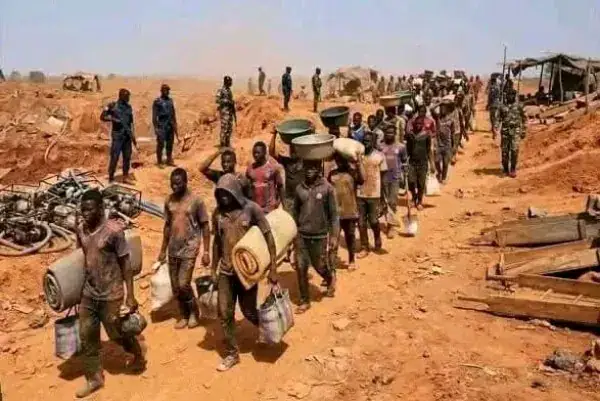
The Malian government has mobilized resources to receive a new wave of miners expelled from Guinea. According to the Centre de coordination et de gestion des crises (Cecogec), this new influx was announced by Guinean authorities and is less significant than previous flows. The center stated that the Malian authorities are working to accelerate the repatriation process by mobilizing necessary human and logistical resources.
On November 13, 2026, Cecogec mobilized 27 trucks in Bamako to transport around 3,240 people. Additionally, 7 buses were made available for women and children, and 10 trucks were deployed to the Kouremalé gathering site to facilitate the return of expelled miners. The Burkinabè authorities also provided 5 trucks to support convoy operations. Cecogec cited the involvement of youth organizations, social workers, economic operators, humanitarian partners, and individuals in supporting the government's efforts.
The Cecogec reaffirmed the government's commitment to ensuring the proper care of those affected and facilitating their dignified and secure return to Mali. On November 14, 2026, Prime Minister General Abdoulaye Maïga chaired a meeting of the Interministerial Committee for Crisis and Disaster Management. The meeting reviewed the repatriation operation for African miners expelled from Guinea.
The Malian government's efforts to receive and support expelled miners coincide with recent developments in the region. Since May, South Africa has experienced xenophobic violence against African nationals. In response, the Malian government, through the Ministry of Malians Abroad and African Integration, has been working to address the situation.
On a separate note, Malian comedian and humorist Cheick Oumar Ndiaye, known as "Paracetamol," passed away on November 13, 2026. The news was announced by Minister of Artisanal, Cultural, Hospitality, and Tourism, Mamou Daffé.
In other news, the Malian Council of Ministers, under the presidency of General Assimi Goïta, adopted texts for the creation of a new organization for surveyor-topographers. This development aims to reorganize the profession and improve its services.
Furthermore, the Regional Cotton-Textile Program aims to transform at least 50% of cotton fiber produced in the community. This objective seeks to add value to cotton production and promote regional economic development.
Key points
- The Malian government has mobilized resources to receive and support a new influx of miners expelled from Guinea.
- The government has committed to ensuring the proper care and dignified return of those affected.
- Recent developments in the region include xenophobic violence in South Africa and the reorganization of the surveyor-topographer profession in Mali.