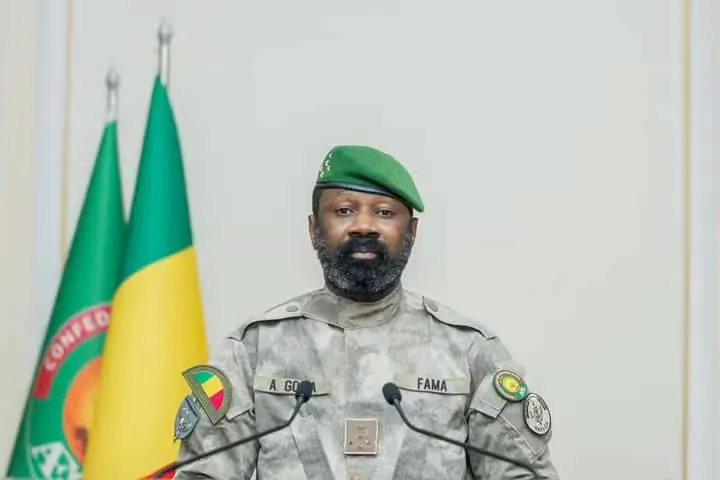
On September 23, 2026, Mali marked its 66th independence anniversary with a message from President Assimi Goïta that highlighted the nation's commitment to sovereignty, refoundation, security, development, and national unity. The President's address was built around eight key areas, focusing on the country's future and its people's aspirations. He emphasized that sovereignty is the cornerstone of Mali's actions, allowing the nation to make its own decisions and act independently, particularly in choosing its partners and defending its national interests.
President Goïta stressed that security and defense of the territory remain top priorities, with the fight against insecurity being a major challenge. He reaffirmed the government's commitment to defending the country's territorial integrity and national unity, while honoring the military personnel who have fallen in the line of duty and the victims of terrorism. The President announced that the government will continue to strengthen its efforts to combat terrorist groups, adapting its defense policy and tools to address the evolving threats.
The President also emphasized Mali's commitment to the Confederation of Sahel States (AES), which aims to reaffirm the sovereignty of its member states while seeking renewed cooperation with sub-regional and regional organizations. He stated that Mali's diplomacy will be guided by the country's interests and sovereign choices. Furthermore, President Goïta highlighted the importance of an economy based on national resources, presenting the concept of "Mali Kura" as a transformative approach that leverages internal resources and valorizes national potential.
According to President Goïta, Mali's economy is expected to grow, with a projected 5.6% increase in GDP in 2025 and 6.3% in 2026. The government's economic strategy focuses on stabilizing prices of essential goods, supporting the rural sector, improving workers' incomes, and promoting the private sector. The mining and infrastructure sectors are also seen as key drivers of economic transformation, with the aim of mobilizing resources to finance local development, energy, water, and transportation infrastructure.
Education and culture were also highlighted as priorities for the 2026-2027 period, which has been declared the Year of Education and Culture. The President emphasized the need for a better-educated population, aware of contemporary challenges and deeply rooted in Malian cultural values. The youth are seen as crucial in shaping the country's future, and the government aims to provide them with the necessary tools to contribute to the nation's development.
President Goïta called for national reconciliation, unity, and cohesion, stressing the importance of building a shared heritage and inviting all Malians to participate in the country's construction. He also extended an invitation to the Malian diaspora to actively engage in the country's development, rather than simply observing from afar. The President's message concluded with a strong emphasis on preserving Mali's ability to "decide and act by itself."
The President's speech has been summarized around six key words: sovereignty, security, AES, economy, education, and unity. The "Mali Kura" project, presented as a vision for a sovereign, united, just, secure, and prosperous Mali, is seen as a long-term strategic goal, aligned with the Mali 2063 vision. The government's focus is now on translating these orientations into concrete actions that will improve the daily lives of Malians, addressing challenges such as security, employment, purchasing power, education, energy, infrastructure, justice, and national cohesion.
Key points
- President Goïta emphasizes Mali's sovereignty and independence in decision-making.
- The government prioritizes security, education, and economic development.
- The "Mali Kura" project aims to transform the country into a sovereign, united, and prosperous nation.