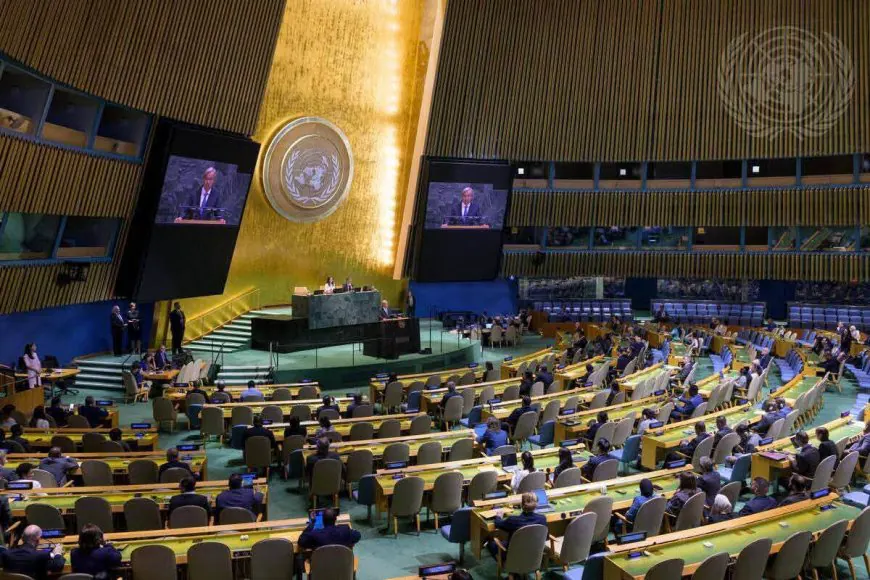
On September 26, 2026, Mali's Foreign Minister Abdoulaye Diop addressed the 81st session of the United Nations General Assembly, emphasizing the need for a reformed multilateralism. He called for a refoundation of the multilateral system based on the sovereign equality of states, non-interference, and respect for territorial integrity. Diop stressed that the current crises and challenges facing the international community require a renewed commitment to these principles.
Diop highlighted that flagrant violations of international law, selective application, and double standards have eroded trust in international institutions. He urged the international community to respect the principles of the UN Charter and to lift unilateral coercive measures that harm state sovereignty and population welfare. The Malian minister also emphasized the need for a more equitable and just international order.
The Sahel region was a significant focus of Diop's address, as he attributed the region's security degradation to the 2011 NATO intervention in Libya. He claimed that this intervention contributed to the spread of terrorism and violent extremism in the Sahel. Diop also accused external actors, particularly Ukraine, of supporting terrorist groups in the region and called on the international community to condemn such actions.
Diop discussed the threat of terrorism in the Sahel, describing it as having military, economic, and media dimensions. He cited recent attacks in Mali, including those on April 25 and July 4, 2026, as examples of the "dangerous connection" between armed groups. In response to this security situation, Diop defended the creation of the Confederation of Sahel States (AES), which brings together Burkina Faso, Mali, and Niger.
The AES, established on July 6, 2024, aims to strengthen security, political, and economic cooperation among its member states. Diop reaffirmed the determination of AES leaders to continue fighting terrorism and highlighted the engagement of Malian forces, the Unified Force of AES, and their partners, including Russia, on the security front.
Diop reiterated Mali's openness to international cooperation while emphasizing the need for respect for the country's sovereignty and strategic choices. He stated that Mali will pursue a foreign policy based on good neighborliness, non-interference, and peaceful dispute resolution. The minister also underscored the importance of economic sovereignty, stressing that Mali's sovereignty is not negotiable and must extend beyond territorial defense to economic decision-making.
Diop presented Mali's Vision 2063 and the National Strategy for Emergence and Sustainable Development (SNEDD 2024-2033) as key frameworks for achieving economic transformation. He advocated for greater mobilization of internal resources, arguing that international aid alone cannot finance African countries' development. Diop called for new, non-conditional financing mechanisms that do not consider geopolitical factors.
Key points
- Mali's Foreign Minister Abdoulaye Diop calls for a reformed multilateralism at the UN General Assembly.
- Diop emphasizes the need for respect for state sovereignty and strategic autonomy in addressing global crises.
- Mali advocates for a more equitable international order and greater mobilization of internal resources to finance development.