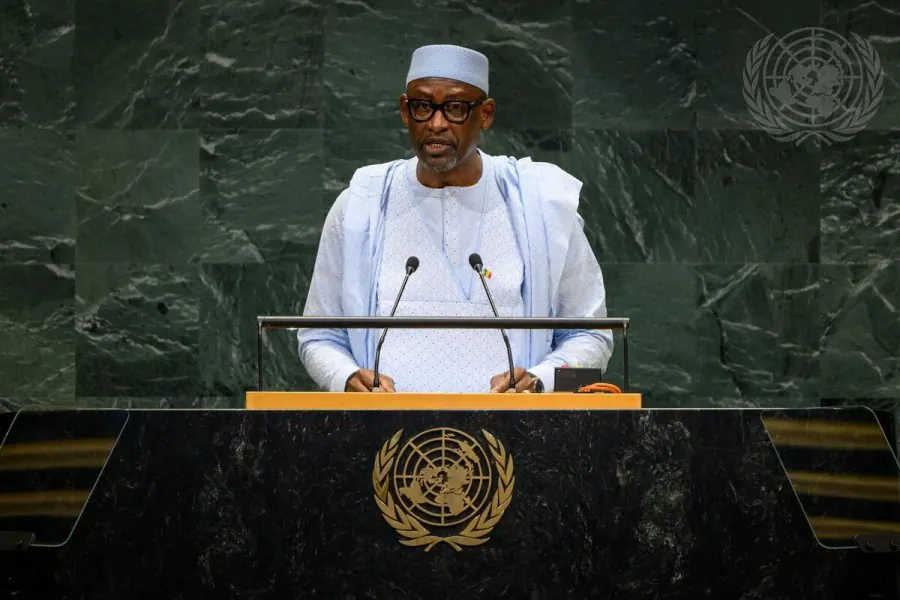
On September 28, 2026, Mali's Minister of Foreign Affairs, Diop, delivered a statement at the 81st session of the UN General Assembly on behalf of President Assimi Goïta. The statement emphasized Mali's commitment to a reformed multilateralism, based on the strict respect of the UN Charter. Diop highlighted the importance of equal sovereignty of states, respect for territorial integrity, and non-interference in internal affairs. He also recalled that Mali had joined the UN on September 28, 1960, six days after gaining independence.
Diop expressed concerns about the erosion of trust in international institutions due to selective application of international law and double standards. He called for the lifting of unilateral coercive measures, which he believes undermine state sovereignty and harm populations in several countries. The Minister also addressed the security crisis in the Sahel region, attributing it to the 2011 NATO intervention in Libya, which he claimed exacerbated the situation and facilitated the spread of terrorism.
The Malian government condemned international terrorism and its foreign state sponsors, directly accusing Ukraine of supporting terrorist groups in the Sahel region. Diop cited Ukrainian statements from 2024 and presented them as evidence, along with independent sources. He urged the international community, particularly Africa, not to remain silent in the face of these actions, which he described as a visible part of a destabilization effort aimed at breaking the will of Sahel countries to emancipate.
Diop described terrorism as being sustained and supported, manifesting in three forms: armed attacks against populations and defense forces; economic attacks aimed at asphyxiating countries; and media disinformation, which Mali attributes to certain "nostalgic" media outlets from a colonial past. He cited recent coordinated attacks on April 25 and July 4, 2026, as evidence of a "dangerous connection" between terrorist and separatist groups.
In response to the security situation, Diop defended the creation of the Alliance of Sahel States (AES), established on July 6, 2024, by Mali, Burkina Faso, and Niger. He stated that Malian forces are fighting terrorism alone and with the support of Russia, while welcoming partners who continue to support the country. Diop emphasized that the AES is open to all partners who respect the sovereignty and strategic choices of its members.
On the domestic front, Diop stressed that Mali's sovereignty is "non-negotiable" and goes beyond defending territory to include control over economic choices, valorizing natural resources, and creating opportunities for youth. The government reaffirmed its commitment to the Vision Mali Kura 2063 and the National Strategy for Emergence and Sustainable Development 2024-2033. Diop called for increased mobilization of domestic resources, arguing that international aid, while useful, has never developed a country.
Finally, Diop described an international order "at the hour of great change," advocating for cooperation rather than confrontation between poles in a multipolar world. He emphasized Mali's goal of strategic autonomy for the AES and Africa, presented as a means to make the continent a credible partner. The Minister also addressed thematic issues, including climate change, desertification, and artificial intelligence, which Mali aims to master as a technology.
Key points
- Mali's Minister Diop called for a refounded UN and criticized Ukraine's support for terrorist groups in the Sahel region.
- The Malian government emphasized its commitment to sovereignty and non-negotiable choices, including control over economic decisions and natural resources.
- Diop advocated for a multipolar world order and cooperation between international poles, highlighting Mali's goal of strategic autonomy for the AES and Africa.