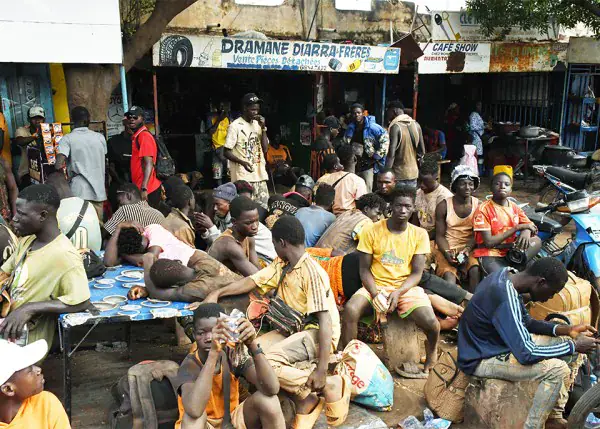
The streets of Bamako, particularly around the Burkina Faso embassy, are filled with men, women, and children from various nationalities, including Ghanaians, Beninese, Nigeriens, Burkinabes, and others. They were forced to leave their gold mining sites in Guinea's Siguiri region after the government cracked down on informal mining. Many are exhausted, carrying few belongings, and waiting for transportation to continue their journey back to their home countries. The youngest among them is just 11 years old.
The expelled miners had been working on various sites in Guinea, some for years, and were suddenly forced to abandon their livelihoods without being able to recover their savings or personal belongings. Khorgo Salif, a 25-year-old Ivorian, had been working in Guinea for a year, earning a million Fcfa annually, and was well-fed and accommodated. He arrived in Bamako last Sunday and feels a sense of relief after the difficult journey. Many others, like Ami Nankwande, a Burkinabe woman, had a traumatic experience, walking for two days without food or shelter before finding a bus to Bamako.
The ordeal of Simon Boubougou, a Burkinabe, is even more harrowing. He was working on a mining site in Didi, Guinea, with his wife and brothers when they were violently forced to leave. He claims they were physically abused and tear-gassed. Rosalie Pasco, another expelled miner, walked for five days to reach Mali and now wants to return home, saying the situation is unbearable. Silvain Ouédraogo, a young Burkinabe, lost nine months of work when he was suddenly expelled from his mining site in Kolena, Guinea, and is now sleeping on the streets of Bamako.
Despite the distressing stories, Bamako is showing a face of solidarity. Locals are mobilizing to provide food, water, and transportation to the stranded miners. Many residents are offering free services, including moto-taxi rides and truck rides, to help them continue their journey. Fatasse Konditanbé, a Burkinabe who worked in Guinea for over two years, expressed gratitude for Mali's hospitality, saying many have lost their belongings and some have even died.
The Malian authorities have also taken steps to organize the reception and care of the expelled miners. The army has mobilized trucks to gather them in one place while they await further arrangements. In Burkina Faso, President Captain Ibrahim Traoré has expressed his country's willingness to repatriate its citizens with dignity and decency. An emergency meeting was held in Bamako on November 3, where the Centre de coordination et de gestion des crises (CECOGEC) announced measures to ensure a proper welcome and facilitate the return of the miners to their home countries.
The situation has prompted a humanitarian response, with various stakeholders, including governments and local organizations, working together to provide assistance. The Malian government has called for calm, serenity, and civic responsibility, urging citizens to collaborate with the security forces. Meanwhile, several initiatives are underway to support the expelled miners, including food and shelter provision.
As the situation continues to unfold, the international community is watching closely. The expulsion of the gold miners from Guinea has created a regional crisis, with many countries, including Mali, Burkina Faso, and others, working together to find a solution. The Malian government has reiterated its commitment to providing humanitarian assistance to those affected.
Key points
- The crisis has prompted a humanitarian response, with various stakeholders working together to provide assistance to the expelled miners.
- Mali's capital, Bamako, has become a temporary haven for thousands of gold miners expelled from Guinea.
- The Malian authorities, along with other governments and organizations, are working to provide care and transportation to help the miners return home.