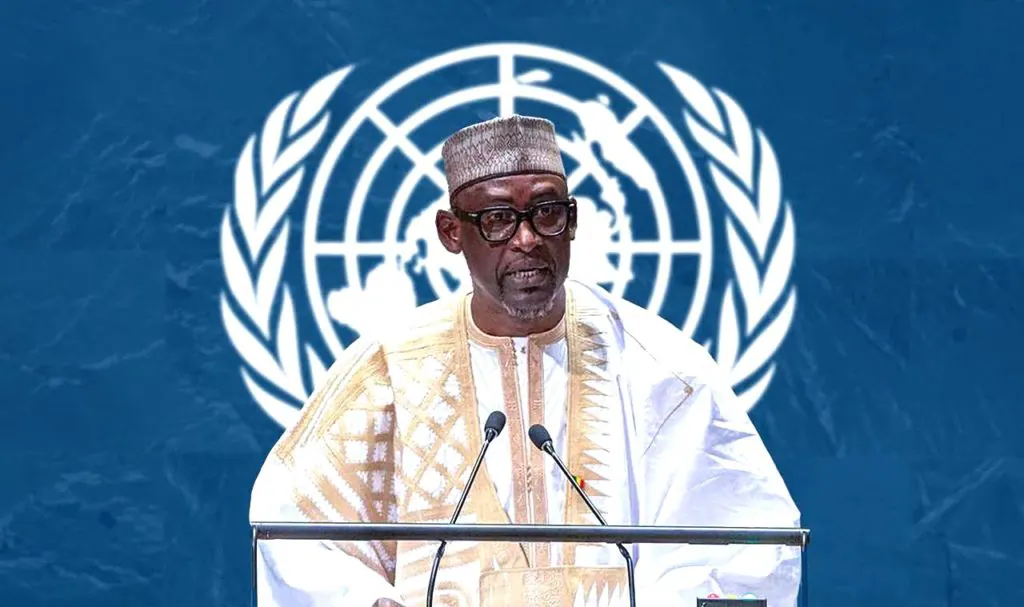
On September 28, 2026, Mali's Foreign Minister Abdoulaye Diop delivered a speech at the 81st session of the UN General Assembly, highlighting the country's commitment to sovereignty and strategic autonomy. Speaking on behalf of President Assimi Goïta, Diop called for a reform of multilateralism and denounced various forms of foreign interference. He criticized the selective application of international law and what he termed as a "double standard" in managing international crises.
Diop expressed concerns that these practices have eroded trust in multilateral institutions. He urged the international community to lift sanctions and coercive measures against several countries and advocated for a reform of global governance. Mali seeks a more equitable representation of Africa in international decision-making bodies. The minister also linked the 2011 NATO intervention in Libya to the deterioration of security in the Sahel region, accusing the intervention of contributing to the spread of terrorism.
The situation in the Sahel was a significant part of Diop's address. He alleged that Ukraine supports terrorist groups operating in the Sahel, viewing this as part of a broader strategy to destabilize Sahelian states. This stance aligns with Mali's previous positions at the UN. The Confédération des États du Sahel (AES), a cooperation framework between Mali, Burkina Faso, and Niger, was also emphasized. Diop reaffirmed the three countries' commitment to making strategic choices without external tutelage.
Diop assured that the AES member states remain open to international cooperation, provided it respects their sovereignty and territorial integrity. He encapsulated this position with the phrase: "We do not have instructions to receive in this regard." Domestically, Mali reiterated its commitment to national dialogue and reconciliation, leaving room for armed groups to reintegrate into society. Economically, the government aims to boost national resource mobilization, particularly focusing on mining resources like gold and lithium.
To reduce dependence on external financing, Mali prioritizes controlling and valorizing its mineral resources. Diop stated that international aid, while useful, cannot solely drive a country's development. He called for enhanced mobilization of internal resources and confidence in national capacities. The development of artificial intelligence was also highlighted, with the creation of Mali's Center for Artificial Intelligence and Robotics aimed at building national expertise in emerging technologies.
For Mali, the goal is not just to adopt technologies developed elsewhere but to create its own capacities to adapt these technologies to national realities. Diop emphasized that artificial intelligence should not only be a technology consumed but also one that Mali masters, adapts, and contributes to developing. This approach aligns with Mali's broader strategy of asserting its sovereignty in various domains.
Mali's address at the UN General Assembly underscored three main priorities: political sovereignty, economic autonomy, and technological mastery. The country advocates for a reform of the multilateral system and increased African representation in international bodies. Through its statements, Mali seeks to reaffirm its commitment to self-determination and cooperation on its own terms.
Key points
- Mali's Foreign Minister Abdoulaye Diop calls for a reform of multilateralism and an end to foreign interference in the country's affairs.
- The minister links the 2011 NATO intervention in Libya to the current security challenges in the Sahel region.
- Mali prioritizes the development of its technological capacities, including artificial intelligence, to assert its sovereignty.