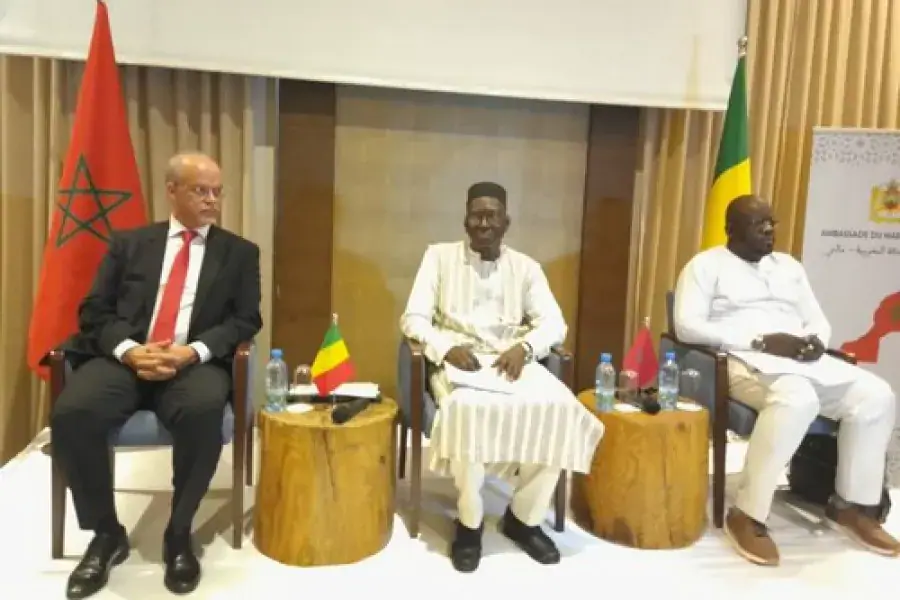
The Moroccan Embassy in Mali, led by Ambassador Driss Isbayene, recently organized a roundtable discussion at the Radisson Collection Hotel in Bamako to commemorate the country's Unity Day, also known as Eid Al-Wahda. This celebration, created by King Mohammed VI and announced on November 4, 2025, marks the national unity and territorial integrity of Morocco. The event brought together notable figures to discuss the significance of this day and the historical ties between Mali and Morocco.
The roundtable discussion featured journalist and writer Daouda Tekete, who presented a comprehensive overview of the 1000-year cooperation between Mali and Morocco. He highlighted the golden age of trade between the two nations during the 11th to 15th centuries, with Mali supplying gold and Morocco exporting salt and textiles. This historical relationship was further documented by travelers such as Ibn Battuta, who wrote about the prosperity of Mali in 1352.
Daouda Tekete also discussed the story of Ahmed Baba, a renowned Malian scholar from Timbuktu, who was arrested and deported to Marrakech in 1594. During his stay in Marrakech, Baba impressed the intellectual circles and Moroccan authorities with his vast knowledge, eventually obtaining his freedom and permission to open a school where he taught for several years. This historical account showcases the deep cultural exchange and connections between the two nations.
The journalist and writer also touched on the post-colonial era, highlighting the meeting between Malian President Modibo Keïta and Moroccan King Mohamed V in Tanger on September 3, 1960. This encounter led to the formation of the Casablanca Group, a bloc of progressive African countries that laid the groundwork for the Organization of African Unity (OAU) in 1963. The OAU aimed to promote African unity and cooperation.
The Casablanca Group played a significant role in promoting African unity, with member states working together on various initiatives. In January 1961, a conference in Casablanca led to the creation of a charter, an assembly, and a committee for political coordination. The group also established specialized committees, including those for politics, economics, and culture. These efforts demonstrated the commitment of Mali and Morocco to African cooperation.
Despite facing challenges, including a disagreement over the Western Sahara issue in 1984, Mali and Morocco have maintained diplomatic channels and strengthened their cooperation. The two countries have worked on concrete projects, with Morocco becoming Mali's primary commercial partner in North Africa and third-largest investor. This cooperation has contributed to the growth and development of both nations.
The celebration of Morocco's Unity Day in Bamako serves as a testament to the enduring relationship between Mali and Morocco. As both countries continue to build on their historical ties, they are working towards a future of increased cooperation and mutual benefit. The event highlighted the importance of understanding and embracing their shared history to foster a stronger partnership.
Key points
- The historical ties between Mali and Morocco date back over 1000 years, with significant periods of cooperation and cultural exchange.
- The Casablanca Group, formed in 1960, played a crucial role in promoting African unity and cooperation, laying the groundwork for the Organization of African Unity.
- Despite challenges, Mali and Morocco have maintained diplomatic channels and strengthened their cooperation, with Morocco becoming Mali's primary commercial partner in North Africa.