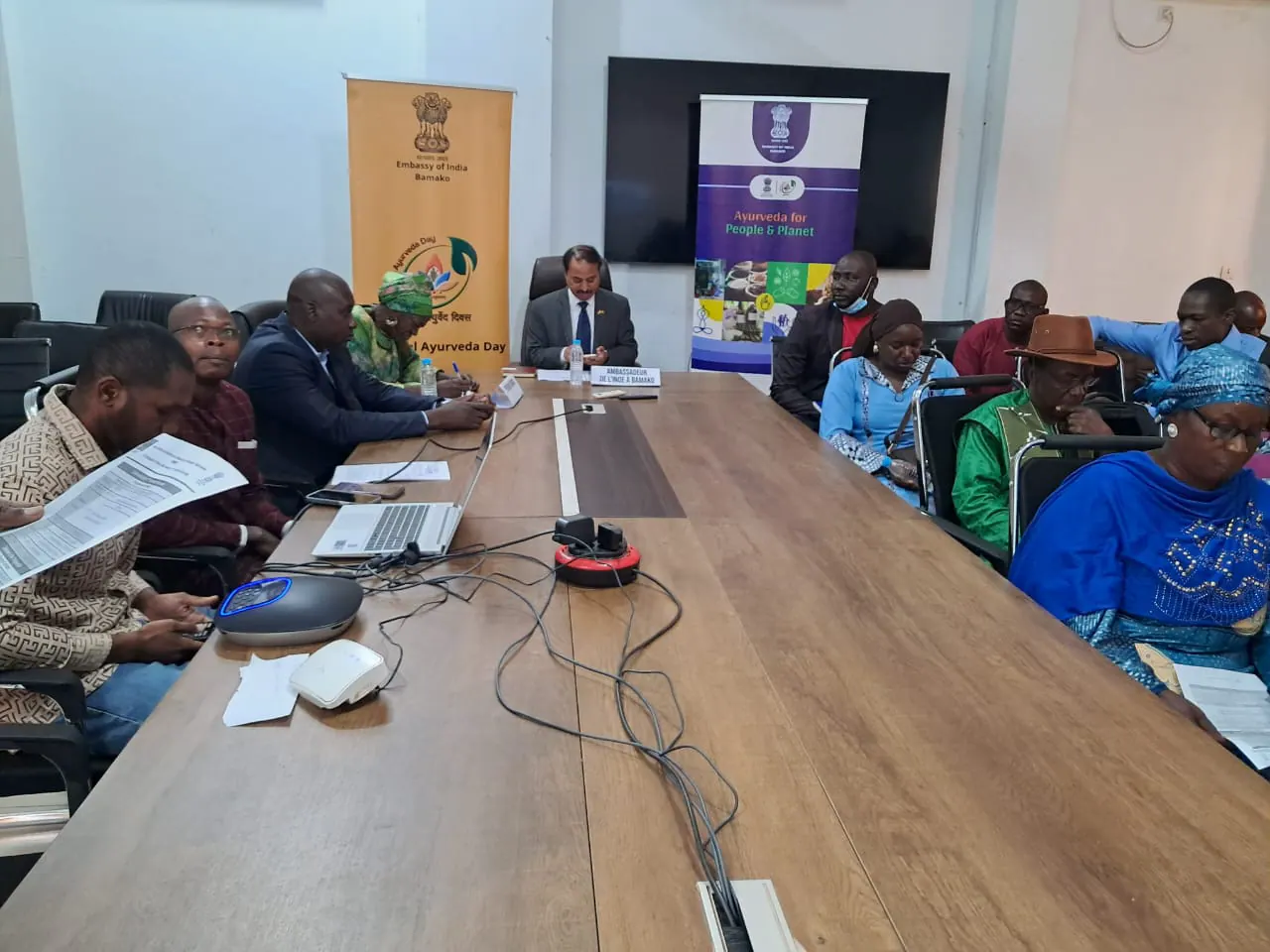
The Indian Embassy in Mali, in partnership with the National Institute for Research on Traditional Medicine and Pharmacopoeia (INRMPT), recently celebrated the 11th Ayurveda Day in Bamako. The event, held at the Institute of Human Sciences, featured discussions on Ayurveda, its principles, and potential cooperation with traditional Malian medicine. The theme of the celebration was "Ayurveda for a Better Tomorrow," with the slogan "One Health, One Future." This event highlighted the long-standing relationship between India and Mali in traditional medicine.
Indian Ambassador to Mali, Dr. Nandakumar, emphasized that Ayurveda, meaning "science of life," is a traditional system of healthcare that has been practiced for over 3,000 years. It focuses on prevention and achieving balance between the body, mind, and environment. The ambassador noted that the celebration's timing, during the autumnal equinox, symbolizes the pursuit of global balance, a core aspect of Ayurvedic philosophy. He stressed the importance of integrating traditional knowledge with modern scientific advancements.
Dr. Nandakumar highlighted the need for collaborative efforts in integrative healthcare, research, innovation, and harnessing natural resources. Both India and Mali have a rich tradition of traditional medicine, and he commended Mali's efforts in researching and valorizing its traditional medicines. The ambassador expressed hope that this celebration would strengthen the partnership between the two countries in this field.
Dr. Rokia Sanogo, Director-General of INRMPT, described the event as a significant opportunity for visibility and cooperation in traditional Malian medicine. She noted that the institute's participation followed a meeting with the Indian Ambassador, where they discussed the institute's research activities in traditional medicine. Sanogo emphasized that the partnership with India presents a great opportunity for Mali to benefit from Indian expertise.
Sanogo shared her experience of visiting India, where she observed the country's organized approach to traditional medicine, including specialized structures for training, research, and practice. She noted that India has made significant progress in professionalizing traditional medicine and integrating it into the healthcare system. The director-general expressed her desire for Mali to replicate this model.
The celebration featured various communications and discussions on Ayurveda, its principles, and its potential applications. The event brought together experts and stakeholders from both countries to share knowledge and experiences. This exchange aimed to promote cooperation and collaboration in traditional medicine.
The partnership between India and Mali is expected to enhance the development of traditional medicine in both countries. The two nations can learn from each other's experiences and strengthen their cooperation in this field. Key areas of collaboration may include research, training, and the integration of traditional medicine into national healthcare systems.
Key points
- The 11th Ayurveda Day celebration in Bamako marked a significant milestone in the partnership between India and Mali in traditional medicine.
- The event highlighted the importance of integrating traditional knowledge with modern scientific advancements.
- The partnership aims to promote cooperation and collaboration in traditional medicine, research, and healthcare.