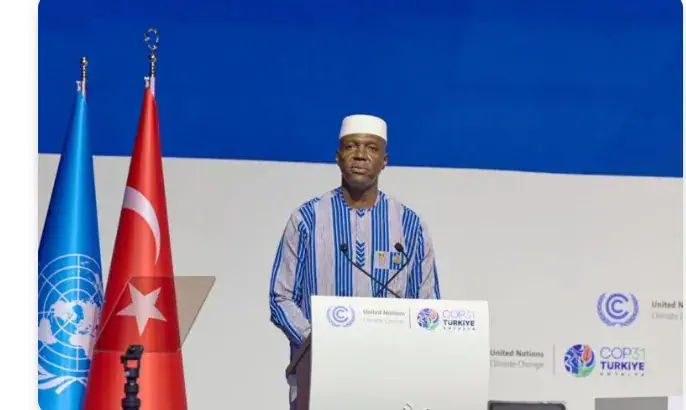
The Malian government has announced plans to develop 4,142 megawatts-crête (MWc) of solar power as part of its long-term energy strategy. This move aims to address the country's electricity access challenges, with nearly half of its population currently lacking access to electricity. According to the World Bank, Mali's electricity access rate stood at 49.5% in 2024. The country's Prime Minister, Abdoulaye Maïga, made the announcement at the COP31 conference in Antalya, Türkiye.
The lack of electricity access poses significant challenges to households, social services, and economic activities in Mali. The country's energy strategy, including the "Yelen Kura" program, is integrated into its national development strategy for 2063. The program aims to increase electricity access and reduce greenhouse gas emissions. Maïga emphasized that the development of solar power is crucial to achieving these goals and addressing the country's vulnerability to climate change.
The Malian government's plan to develop 4,142 MWc of solar power is expected to reduce carbon dioxide emissions by 132 million tons over the lifetime of the installations. The Prime Minister's projections indicate that this will contribute significantly to the country's climate goals. Mali also aims to strengthen its hydroelectric power capacity and explore nuclear energy to diversify its energy mix.
The implementation of Mali's solar power plan depends on the development of electricity grids and storage capacity necessary for integrating new energy sources. However, the government has not provided a detailed timeline or financing plan for the project. The country's third Nationally Determined Contribution (CDN 3.0), validated on October 1, 2026, aims to reduce greenhouse gas emissions by 25.25% by 2035 in the energy, agriculture, and waste sectors.
Mali is highly vulnerable to climate change, with agriculture heavily dependent on rainfall and frequent droughts and floods affecting the country. As of September 25, 2026, severe weather had affected 12,405 people, causing 13 deaths and 479 building collapses. The government is working to restore degraded lands and rehabilitate the Niger and Senegal rivers, which support many agricultural and economic activities.
Prime Minister Maïga also called for better access to international climate finance for vulnerable countries, highlighting the constraints posed by debt and limited resources in African states. Mali is advocating for a reform of international financial mechanisms to take greater account of climate vulnerability in resource allocation. The country's efforts to transition to renewable energy and adapt to climate change are critical to its development strategy.
The success of Mali's climate and energy plans depends on the mobilization of financing and the development of necessary infrastructure to translate these ambitions into concrete improvements in living conditions. The government faces significant challenges in achieving its goals, but its commitment to sustainable development and climate resilience is clear. The international community's support will be crucial in helping Mali achieve its objectives.
Key points
- Mali aims to develop 4,142 MWc of solar power to increase electricity access
- The project is expected to reduce carbon dioxide emissions by 132 million tons
- Mali is vulnerable to climate change, with frequent droughts and floods affecting the country
Reporting sources
- COP31 : le Mali mise sur 4 142 MWc de solaire pour élargir l’accès à l’électricité · Gabon Press Agency