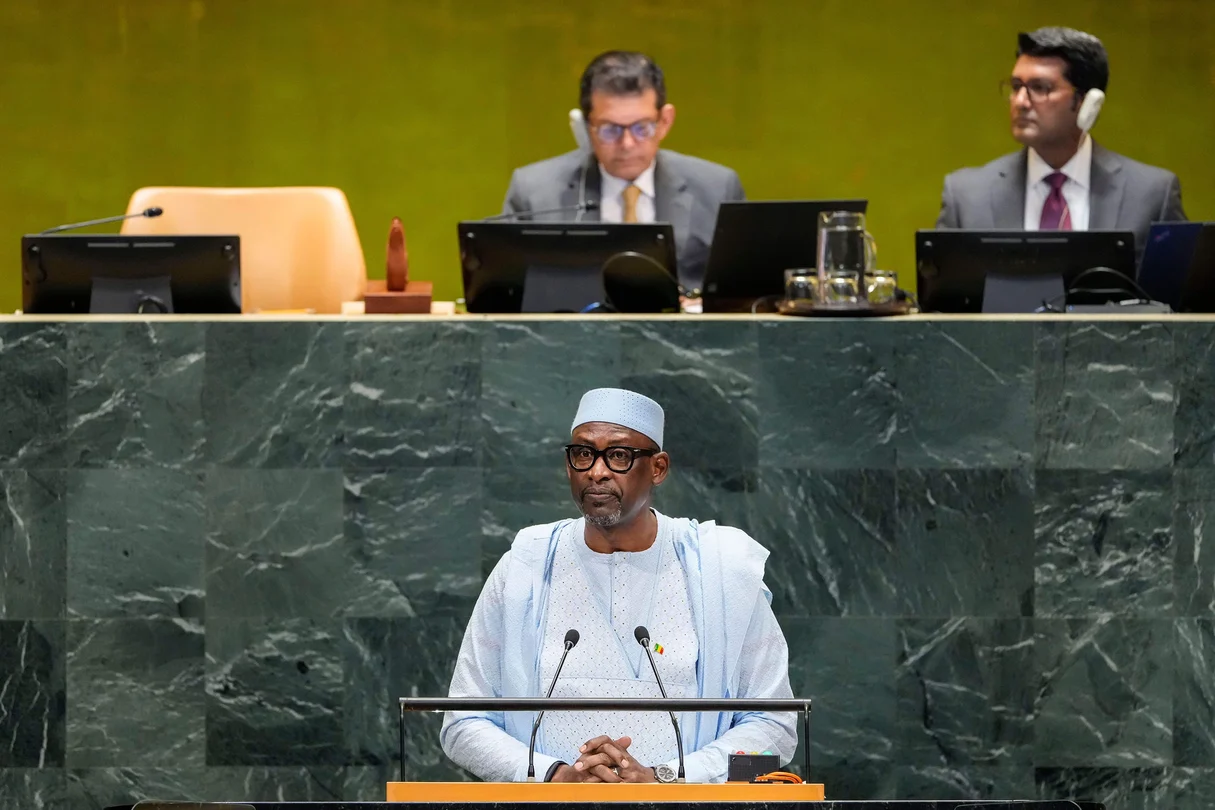
On September 28, 2026, Mali's Foreign Minister and International Cooperation, Abdoulaye Diop, delivered a speech at the 81st session of the United Nations General Assembly in New York. Speaking on behalf of Mali's Transitional President, General Assimi Goïta, Diop focused on sovereignty, counter-terrorism, strategic autonomy, and reforming the multilateral system. He called for international cooperation based on mutual respect and defended the Alliance of Sahel States (AES) strategy.
Diop's address centered on the theme of the session: "Restoring Trust, Accompanying Transformations: A United Nations in Service of All." He emphasized the need to return to the fundamental principles of the UN Charter, including sovereign equality of states, respect for territorial integrity, non-interference in internal affairs, and peaceful settlement of disputes. Diop criticized the selective application of international law and the use of unilateral sanctions, which he believes undermine state sovereignty and harm populations.
The situation in the Sahel region was a significant part of Diop's speech. He linked the current crisis to the 2011 NATO intervention in Libya, which he claimed contributed to increased insecurity and terrorism in the Sahel. Diop condemned terrorism and accused certain foreign state actors of supporting armed groups in the region, specifically mentioning Ukraine. He highlighted recent attacks in Mali on April 25 and July 4, 2026, as examples of increased coordination among armed groups.
Diop defended the AES, a confederation of Burkina Faso, Mali, and Niger created on July 6, 2024, as a framework for the three countries to take control of their destiny and coordinate security and development efforts. He reaffirmed the determination of the three states to continue fighting terrorism and noted the role of Malian forces, the Unified Force of the AES, and Russian support. Diop expressed openness to cooperation with partners who respect sovereignty, territorial integrity, and freedom of choice.
Economic sovereignty was another key aspect of Diop's speech. He advocated for a strategy to increase domestic resource mobilization, strengthen productive economies, and reduce dependence on international aid. Diop emphasized that external aid should accompany development but not solely address the structural needs of African countries. This approach is part of Mali's "Vision Mali Kura 2063" and the National Strategy for Emergence and Sustainable Development (SNEDD 2024-2033).
On domestic issues, Diop stated that the government will pursue a comprehensive strategy combining security, stability, and development. He reiterated the offer to fighters willing to lay down their arms and join the Republic, referencing the conclusions of the Inter-Malian Dialogue and the National Charter for Peace and National Reconciliation. Diop honored the Defense and Security Forces and victims of terrorism, particularly General Sadio Camara, who is seen as a symbol of patriotism and sacrifice.
Diop also addressed international issues, including the Palestinian question, climate change, and new technologies. Mali reaffirmed its support for the Palestinian people and their aspiration for a sovereign state. Diop noted that the international system is undergoing profound transformations, with a focus on how different poles can cooperate. He called for increased access to climate financing and technologies adapted to Sahel realities, while linking policies on desertification, food security, water management, and peace.
Key points
- Mali's Foreign Minister Abdoulaye Diop calls for a reformed multilateralism at the UN.
- Diop emphasizes the need for international cooperation based on mutual respect.
- Mali advocates for increased representation of Africa in international decision-making bodies.