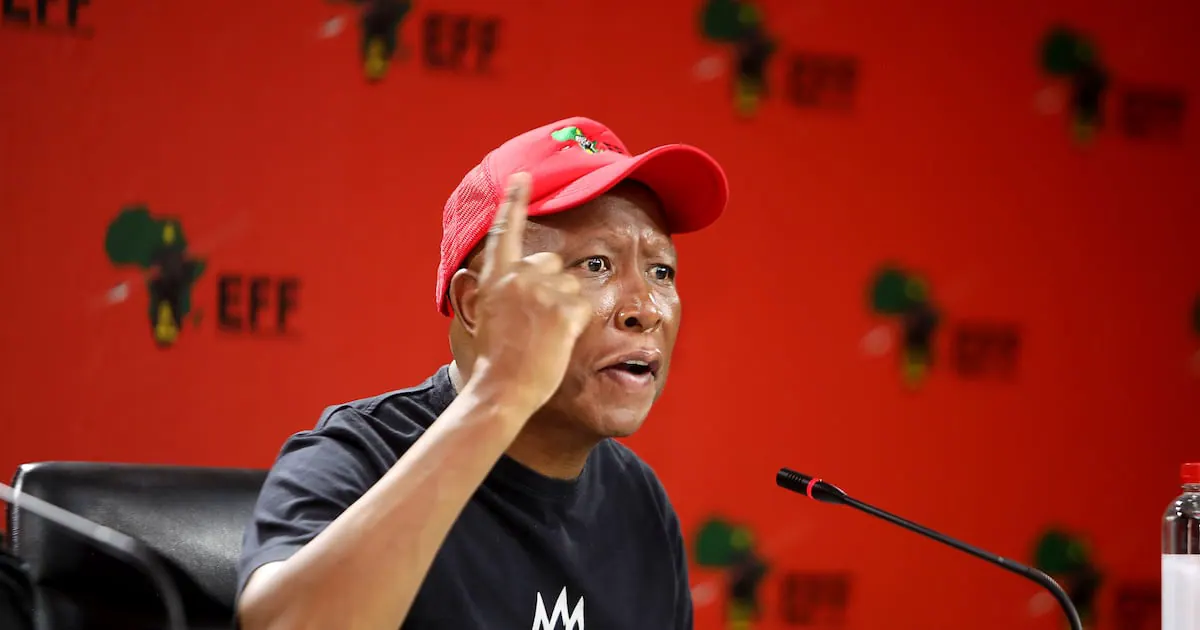
EFF leader Julius Malema has expressed strong opposition to the dissolution of the Investigating Directorate Against Corruption (Idac). During a virtual meeting of parliament's ad hoc committee, Malema argued that the institution itself is not the problem, but rather the lack of accountability mechanisms. He stated that Idac had become a power unto itself due to the absence of an oversight structure. Malema's comments contradict a proposal by the DA to close down Idac and replace it with an independent anti-corruption commission.
Malema attributed the problems within Idac to the individuals occupying it and the lack of early detection mechanisms to hold them accountable. He noted that those who engaged in wrongdoing at Idac resigned quickly when scrutinized, implying that the institution was not equipped to prevent or address misconduct. Malema's sentiments were echoed by ANC MP Mdumiseni Ntuli, who agreed that the problem lies with certain incumbents rather than the directorate itself. Ntuli suggested that addressing the bad elements within Idac would be a more effective approach than closing the entire institution.
The ad hoc committee, which is investigating allegations of corruption and political interference in the criminal justice system, has been finalizing a draft report. Committee chairperson Soviet Lekganyane stated that no final decision has been made regarding whether to recommend Idac's disestablishment. The committee is expected to complete and adopt the report by the end of October. The investigation was initiated following allegations raised by KwaZulu-Natal police commissioner Lt-Gen Nhlanhla Mkhwanazi.
Malema praised former Idac head Andrea Johnson during her committee appearance, comparing her resilience to that of Winnie Madikizela-Mandela. Johnson recently resigned from her post with immediate effect amid an inquiry into her fitness to hold office. In July, retired judge Takalani Joseph Raulinga was appointed as the oversight judge for Idac. Malema noted that the appointment will help ensure legal compliance within the entity.
Malema expressed distrust in other law enforcement agencies, such as the police and the Hawks, describing them as "rotten to the core." He stated that South Africa has accepted a situation where people are easily bribed. ActionSA MP Dereleen James aligned with the EFF and ANC, saying the focus should be on strengthening oversight, monitoring, and vetting, rather than dissolving the entity.
The MK Party disagreed with Malema and the EFF, insisting that Idac must be shut down. MK Party MP David Skosana stated that even with the appointment of judges, the institution will continue to abuse its powers. The party believes that Idac is not necessary and that the country can do without it. The differing opinions within the committee reflect the complexities of addressing corruption and institutional reform in South Africa.
The debate surrounding Idac's fate highlights the challenges of balancing institutional reform with the need for effective anti-corruption measures. As the committee finalizes its report, it will be crucial to consider the perspectives of various stakeholders and the potential implications of dissolving or reforming Idac. The outcome will likely have significant consequences for South Africa's efforts to combat corruption and promote accountability within its institutions.
Key points
- Malema opposes dissolution of Idac, citing lack of accountability mechanisms as the root of the problem.
- The ad hoc committee is expected to complete and adopt its report by the end of October.
- The MK Party insists that Idac must be shut down, citing concerns about the institution's abuse of power.