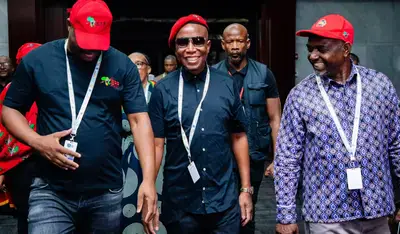
Economic Freedom Fighters (EFF) leader Julius Malema has called for a united front among progressive parties after the EFF suffered significant losses in the 2026 local government elections. The party received approximately 1.8 million votes, representing 6.26% of the national vote, compared to 2.4 million votes and 10.31% in the 2021 local government elections. This represents a loss of 612,326 votes, resulting in the EFF moving from third to fourth position nationally.
Malema acknowledged the party's declining electoral support, saying they would not hide from the national picture and would not make excuses. He argued that voter apathy remained a challenge, with some residents becoming disillusioned with elections due to continued poor living conditions despite voting for political change. Malema emphasized that political parties could not expect people to keep turning out to vote if they could not demonstrate that their participation made a difference in people's everyday lives.
The EFF leader announced that the party would direct a significant portion of its organisational resources towards the 37 wards it won, with a 100-day programme targeting immediate challenges facing residents. Malema said the EFF must start engaging in service delivery programmes in the wards where they won, focusing on issues such as water shortages and deteriorating roads. He suggested that the EFF could use its own resources to install water infrastructure and undertake smaller road improvements.
Malema called for greater cooperation among progressive political organisations, specifically mentioning the EFF, ANC, uMkhonto weSizwe (MK) Party, and the South African Communist Party. He argued that political differences and personal rivalries had weakened organisations that shared similar positions on issues such as land redistribution, affirmative action, and economic transformation. Malema was critical of the ANC's decision to enter into a government of national unity with the Democratic Alliance (DA).
Malema rejected suggestions that the DA had stolen votes from his party, arguing that the ANC had helped legitimise the DA by deciding to work with it in national government. He warned that the EFF would not simply accept unreasonable demands to secure government positions in coalition negotiations. Malema also criticised attempts to portray ActionSA as one of the country's major political parties, arguing that electoral support should determine the influence parties have in negotiations.
Malema reserved some of his strongest remarks for young people who had become disengaged from voting, describing electoral participation as essential to the country's democratic progress. He argued that encouraging people to stay away from the polls would only weaken their ability to influence political decisions. Despite the losses, Malema maintained that the EFF remained an important political force and would use the results to reorganise and prepare for the 2029 national and provincial elections.
For ordinary South Africans, the more immediate test will be whether the party can translate its promises into tangible improvements in the communities it represents. Malema said the EFF would continue fighting for its political programme, whether in government or opposition, insisting that the election results would not mark the end of the organisation's political journey. "We have come too far to let a setback define the end of our game," he said.
Key points
- Malema calls for a united front among progressive parties after EFF electoral losses.
- EFF to focus on service delivery in 37 wards it won.
- Malema criticises ANC's decision to enter into a government of national unity with DA.
Reporting sources
- Malema calls for progressive alliance as EFF confronts electoral losses · Mail & Guardian