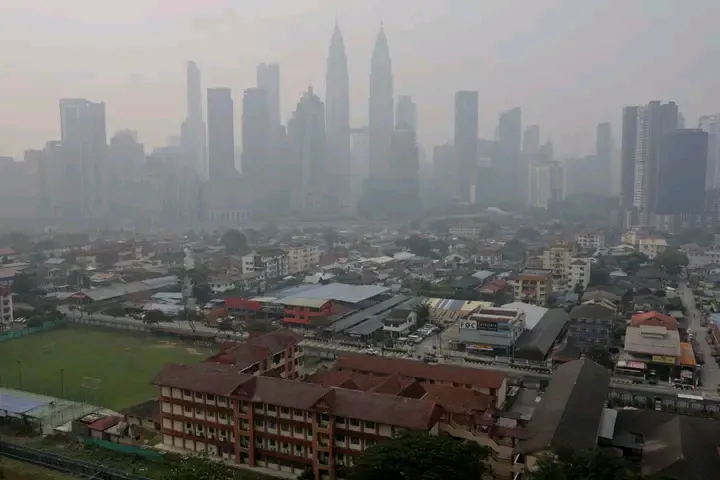
Malaysia has closed schools in several states and federal territories due to thick smoke from forest and peatland fires in neighbouring Indonesia, which has spread across Southeast Asia, pushing air pollution to unhealthy levels. The school closures took effect on Friday, October 9, 2026, following worsening air quality in several parts of Malaysia. The affected areas include Kuala Lumpur, Putrajaya, Johor, Malacca, Negeri Sembilan and Selangor, as well as parts of Pahang.
The decision to close schools was made to protect students and school staff from prolonged exposure to polluted air. Approximately two million students were affected by the closures. Education authorities instructed affected schools to arrange home-based learning where possible so that students could continue their studies while pollution levels remained high. This move aims to minimize the impact of the haze on students' education.
The haze has also affected Malaysia's major urban centres, with Kuala Lumpur recording an Air Pollutant Index reading of approximately 170 on Friday, a level classified as unhealthy under Malaysian guidelines. Authorities have urged residents to take precautions, particularly children, older people and individuals with respiratory illnesses. The smoke originates from forest and peatland fires burning in Indonesia, where prolonged dry weather and El Niño conditions have contributed to an intense fire season.
The fires have affected parts of the islands of Borneo and Sumatra, sending smoke across national borders and disrupting daily life in neighbouring countries. Indonesia is experiencing one of its most severe wildfire seasons in more than a decade. Environmental groups have warned that damaged peatlands are particularly vulnerable because fires can smoulder underground and reignite even after surface flames appear to have diminished.
The consequences of the fires have extended beyond air pollution, with residents in affected Indonesian communities reporting respiratory problems, disruptions to transport and difficulties attending school. Health authorities in Indonesia have recorded more than 170,000 respiratory infections during the crisis, although the actual number of people affected may be higher. The situation has also affected Singapore and reached other parts of the region, including the Philippines.
Malaysia's Prime Minister Anwar Ibrahim said he had spoken with Indonesian President Prabowo Subianto about the worsening situation and urged action to address the causes of the haze. Malaysia has also sought an urgent meeting of environment ministers from the Association of Southeast Asian Nations (ASEAN) to coordinate a regional response. Among the measures being considered in Malaysia is cloud seeding, a process intended to encourage rainfall under suitable atmospheric conditions.
The crisis has renewed longstanding concerns about land-clearing practices, forest protection and the management of peatlands in Indonesia. Fires are sometimes deliberately started to clear land for agriculture, while dry weather and degraded ecosystems can make them spread more easily. Authorities in Malaysia continue to monitor pollution levels and may introduce further protective measures if conditions deteriorate. For residents in affected areas, health experts generally advise reducing strenuous outdoor activities and following official health guidance.
Key points
- Malaysia closed schools in several states due to haze from Indonesian forest fires.
- The haze has affected millions of people across Southeast Asia, with over 170,000 respiratory infections reported in Indonesia.
- The crisis has renewed concerns about land-clearing practices and forest protection in Indonesia.