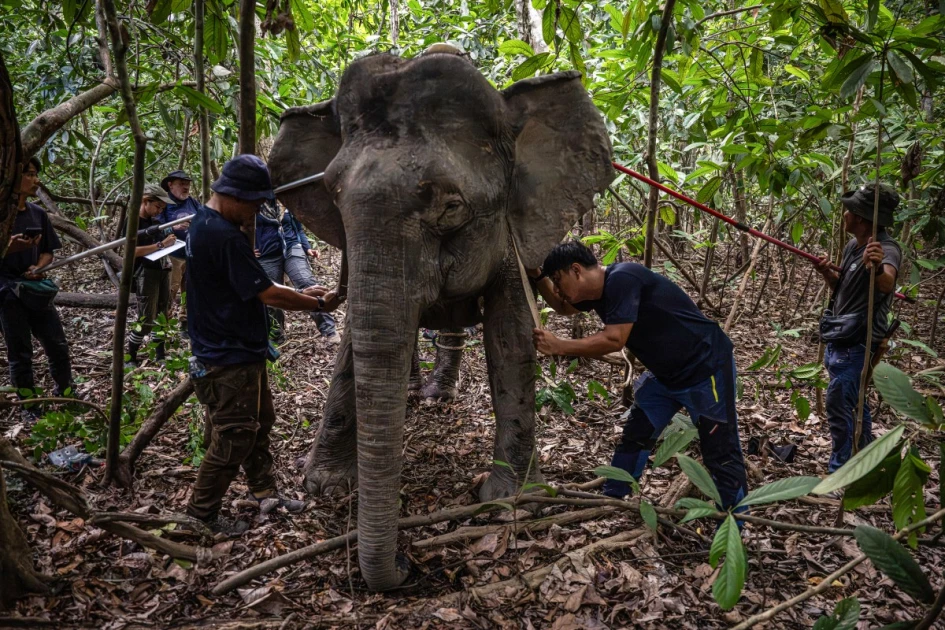
Deep in Malaysia's Borneo jungle, a team of conservationists led by Farina Othman, also known as "Borneo's elephant whisperer," is working to protect the endangered Bornean elephant. The team uses GPS collars to track the elephants and alert villagers if they stray too near. This initiative is part of a collaboration involving several agencies to minimize growing conflict between the animals and local communities. With only around 1,000 Bornean elephants left in the wild, the team's efforts are crucial to the species' survival.
Farina has studied Bornean elephants for years, earning her the prestigious Whitley Award for conservationists. Her team, Seratu Aatai, or "Solidarity" in the local Sungai language, works fast to attach tracking collars and take blood samples from the tranquilized elephants. The team faces challenges, including a limited window of time to complete their tasks, as the dart's sedative effects last only half an hour. The herd can still be heard nearby, and the team must retreat into the forest before the elephant rouses.
For the past 40 years, Bornean elephants have lost more than 60 percent of their habitat in Sabah, northern Borneo, to logging and oil palm expansion. According to the International Union for Conservation of Nature, the animal was listed as endangered in 2024. Lower Kinabatangan, a floodplain in eastern Sabah, is home to around 160 elephants, but only half of that area is now a space left for the elephants. Farina believes that conflict between humans and elephants is inevitable when the animals venture into private property or nearby villages.
Farina and her team of 17 conservationists prioritize coexistence between humans and elephants. They run an outreach program in plantation schools, distribute information pamphlets, and have designated "community wildlife guardians" who help usher away elephants that have wandered into human habitation. The team also works to increase people's tolerance and find a long-term solution to the conflict. By educating locals on safe ways to guide elephants away from their homes, the team aims to reduce the animosity between humans and elephants.
The animosity worsens when adventurous bulls, which can weigh up to five tonnes, cleverly bypass electric fencing to feast on palm trees or saplings. Farina believes that creating "elephant corridors" – pathways through plantations connecting patches of habitat – is the best way to protect the animals. She hopes to convince seven plantations in the area that elephants are "an ecological reality, rather than an occasional disturbance." However, it will be a challenge, as fierce competition driven by tight, volatile margins means many producers are not keen to sacrifice land for corridors.
Industry-funded conservation associations say plantations have made progress in becoming sustainable palm oil producers but face difficult economic realities. It needs to be a win-win situation between the planters and the wildlife. Farina believes that change will come, and locals are starting to adopt a new mindset. Instead of using the Malay word "halau," meaning "chase away" or "banish," when talking about elephants, they are working to get people to say "walking" or "escorting" out the elephant.
Local residents, such as homestay owner Firah Kazenn, have seen the benefits of working with Seratu Aatai. Firah recently encountered elephants behind her home in Sukau but was able to safely guide them away with the help of the conservation team. The community is actively involved in protecting the elephants, and Firah believes that the team's efforts have made a positive impact. With continued support and cooperation, Farina and her team may be able to make a significant difference in the conservation of Borneo's endangered giants.
Key points
- Conservationist Farina Othman is working to protect Borneo's endangered elephants by minimizing conflict between the animals and local communities.
- The Bornean elephant has lost more than 60 percent of its habitat in Sabah, northern Borneo, to logging and oil palm expansion.
- Farina's team is creating "elephant corridors" to connect patches of habitat and reduce conflict between humans and elephants.