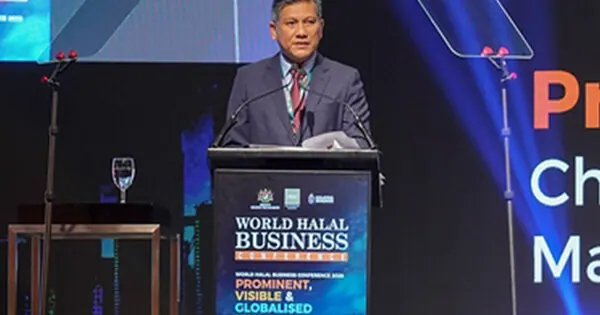
Malaysia is advocating for a shift from being merely halal-certified to becoming halal-competitive as the country and ASEAN aim to tap into the growing global halal economy, projected to reach $5 trillion. This call was made by Minister in the Prime Minister's Department, YB Senator Dr. Zulkifli Hasan, while delivering the keynote address at the World Halal Business Conference (WHBC 2026) in Kuala Lumpur. He emphasized that Malaysia's leadership in the global Islamic economy must translate into greater trade, investment, innovation, and international business opportunities.
Malaysia has retained its position as the number one country in the Global Islamic Economy Indicator (GIEI) for the 12th consecutive year. The country's halal exports reached RM68.52 billion in 2025, growing 10.9% year-on-year. Dr. Zulkifli Hasan stressed that Malaysia must move from being halal-certified to halal-competitive, from market-ready to export-ready, and from local players to global champions. This involves greater emphasis on commercialization, international market access, and participation in global value chains.
The Minister also called for ASEAN to evolve beyond being a halal consumer market into an integrated production, investment, innovation, supply-chain, and global trade hub. To achieve this, Malaysia will promote the proposal for an ASEAN Halal Council to strengthen regional cooperation and connectivity across the halal ecosystem. This move aims to enhance the region's capacity to capitalize on the growing global demand for halal products.
The 18th edition of WHBC, organized by Halal Development Corporation Berhad (HDC) as part of the Global Halal Summit (GHaS) 2026, featured high-level discussions on halal diplomacy, the global Islamic economy, halal export commercialization, and Islamic finance. The conference also witnessed the exchange of two memoranda of understanding (MOUs). HDC formalized a strategic collaboration with King's Park Development Sdn Bhd to strengthen the halal ecosystem through advisory, technical guidance, and capacity-building initiatives.
Another MOU was signed between Tradewinds (M) Berhad and Saudi Arabia's Tanmiah Food Company to explore halal protein opportunities spanning production, sourcing, importation, further processing, and distribution in Malaysia and the Asia-Pacific region. These collaborations aim to translate dialogue into tangible industry partnerships and drive growth in the halal economy.
Dr. Zulkifli Hasan emphasized that the future of the halal economy should be measured not only by the number of halal-certified products but also by the number of companies achieving global growth, investment attracted, value created, quality jobs generated, and deeper integration into ASEAN and global value chains. This shift in focus is crucial for Malaysia and ASEAN to remain competitive in the global halal market.
The World Halal Business Conference 2026 brought together industry leaders, policymakers, and experts to discuss the latest trends and opportunities in the halal economy. With Malaysia leading the charge, ASEAN is poised to capitalize on the growing demand for halal products and services, driving economic growth and development in the region.
Key points
- Malaysia aims to shift from being halal-certified to halal-competitive to capture greater opportunities in the $5 trillion global halal economy.
- ASEAN targets to become an integrated production, investment, innovation, supply-chain, and global trade hub to tap into the growing global halal market.
- Malaysia's halal exports reached RM68.52 billion in 2025, growing 10.9% year-on-year.