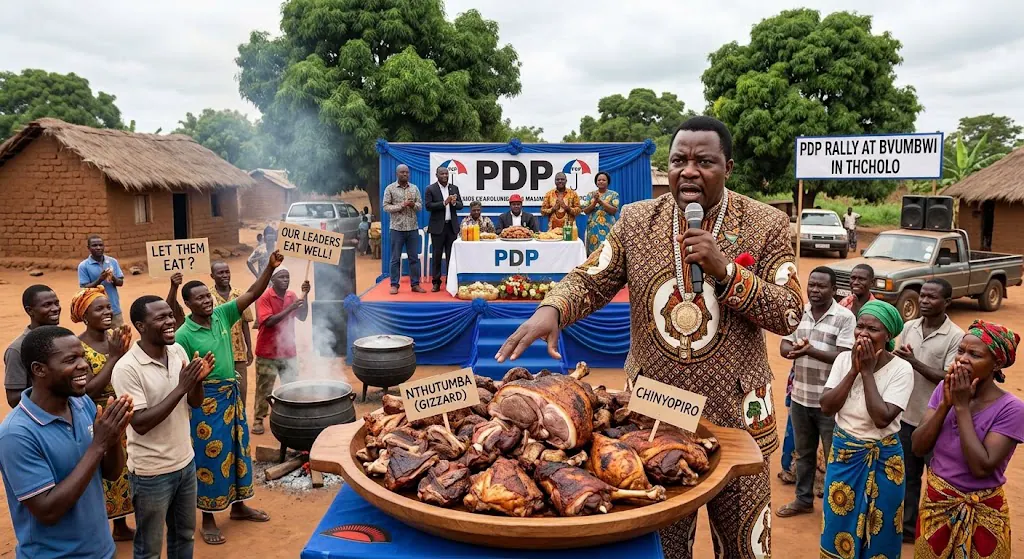
In a recent opinion piece published in The Nation, a columnist known as John Citizen Emmanuel Luciano weighed in on the topic of governance in Malawi. The columnist argued that politics in the country has always been about those in power taking care of themselves. This viewpoint was expressed in response to public criticism of statements made by leaders of the People’s Demagogic Party (PDP) at a recent rally in Tcholo. The PDP leaders reportedly stated that politics is the private business of eating for incumbent politicians.
The columnist drew parallels between the way leaders are treated in society and traditional household dynamics. In many Malawian households, the best portions of a meal are reserved for the head of the household. The columnist cited the example of the Sunday chicken, where the finest portions, specifically the nthutumba (gizzard) and choice cuts of chinyopiro, are strictly reserved for the father of the house. This cultural practice is also observed in village funerals, where local chiefs, village heads, and their indunas are served specially prepared delicacies.
According to the columnist, these cultural practices teach us that leaders need to be well-fed to govern effectively. The columnist argued that a malnourished leader would fail to manage their household, let alone make important decisions for the country. The columnist believes that the best cuts of meat, such as the nthutumba, provide the vital nutrients required to stimulate high-level statecraft. This, in turn, enables leaders to tackle complex national issues.
The columnist highlighted the immense intellectual bandwidth required to manage Malawi's most pressing national crises. These crises include ensuring an adequate supply of LP gas and stabilizing fuel and commodity prices. The columnist argued that these tasks demand sharp and well-oiled minds, which can only be achieved if leaders are exceptionally well-fed.
The columnist also referenced the economic challenges facing Malawi, which were allegedly caused by the preceding Cockerel regime. The columnist believes that the current leaders must be in peak physical and mental shape to steer the country out of economic difficulties. To achieve this, the columnist insists that the PDP leaders must feast on the finest national cuisine.
While some may criticize this viewpoint, the columnist argued that history teaches us that real African leaders cannot possibly govern effectively if they are suffering from political marasmus or kwashiorkor. The columnist concluded that if the leaders consume the entire national carcass, leaving the rest of the population with little, we can at least take comfort in the fact that they sacrificed their digestion for the motherland.
The columnist's opinion piece has sparked debate about governance and leadership in Malawi. While some may agree with the columnist's viewpoint, others may disagree. The columnist's argument highlights the complexities of leadership and the challenges faced by those in power.
Key points
- The columnist argues that leaders in Malawi need to be well-fed to govern effectively.
- The columnist drew parallels between traditional household dynamics and the way leaders are treated in society.
- The columnist believes that the current leaders must be in peak physical and mental shape to steer the country out of economic difficulties.