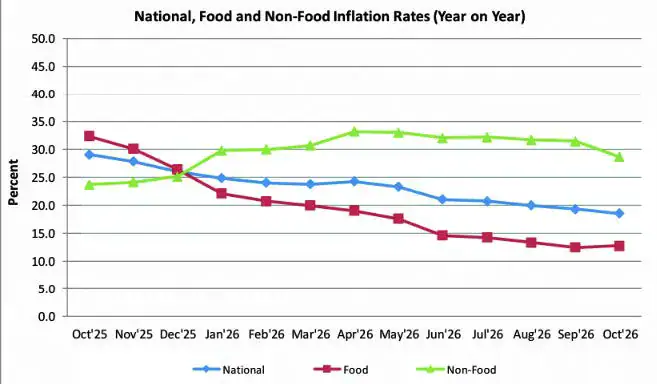
Malawi's headline inflation rate has decreased to 18.6 percent in October, the lowest in four years, according to the National Statistical Office (NSO). This represents a decline of 10.5 percentage points from 29.1 percent recorded in October last year. The NSO reports that inflation has been on a downward trend since April 2022. The decline in inflation rate indicates that prices are rising more slowly than a year ago.
Despite the overall decline in inflation, food prices are increasing, posing a threat to further gains. The food inflation rate rose to 12.8 percent from 12.5 percent in September, while non-food inflation declined to 28.7 percent in October from 31.5 percent the previous month. Monthly food inflation accelerated to 2 percent from 1.1 percent, suggesting that food-price pressures are intensifying.
The Reserve Bank of Malawi (RBM) projects annual average inflation of 22 percent in 2026, down from 28.4 percent in 2025. The RBM also revised its 2027 annual average inflation projection upwards to 20 percent from 18.5 percent. The government's target is to reduce inflation to 15 percent by the end of the 2026/27 financial year. Minister of Finance, Economic Planning and Decentralisation Joseph Mwanamvekha projected inflation to decline to 15 percent by March 2027.
Consumers Association of Malawi executive director John Kapito stated that declining inflation numbers have not translated into meaningful relief for households facing high prices and foreign exchange shortages. Kapito emphasized that inflation affects consumers directly and that persistent foreign exchange shortages and high import costs continue to undermine consumers' purchasing power.
Kisu Simwaka, Ministry of Finance, Economic Planning and Decentralisation Principal Secretary for Economic Planning and Development, described the decline in inflation as encouraging but warned that inflation remains elevated. Simwaka attributed easing non-food inflation to relative exchange-rate stability, reduced fuel-price pressures, and weak consumer demand. He projected inflation will hover between 18 percent and 20 percent through December.
Economics Association of Malawi president Bertha Bangara-Chikadza described sustained disinflation as positive but warned that seasonal food shortages and external shocks could reverse the gains. Bangara-Chikadza noted that the onset of the lean season threatens the price of maize, thereby exacerbating food inflation. She also mentioned that renewed tensions in the Middle East could lead to an increase in fuel prices.
The NSO data shows that inflation rate has been on a sustained downward trajectory throughout 2026, supported by tighter monetary policy, relative exchange rate stability, and easing pressures in some non-food categories. However, the rising food inflation rate poses a threat to further gains. The government and stakeholders must address food supply constraints to achieve the inflation target.
Key points
- The inflation rate in Malawi has declined to 18.6 percent in October, a four-year low.
- Food prices are rising, posing a threat to further gains in reducing inflation.
- The government aims to reduce inflation to 15 percent by the end of the 2026/27 financial year.
Reporting sources
- Food prices threaten inflation gains—NSO · The Nation