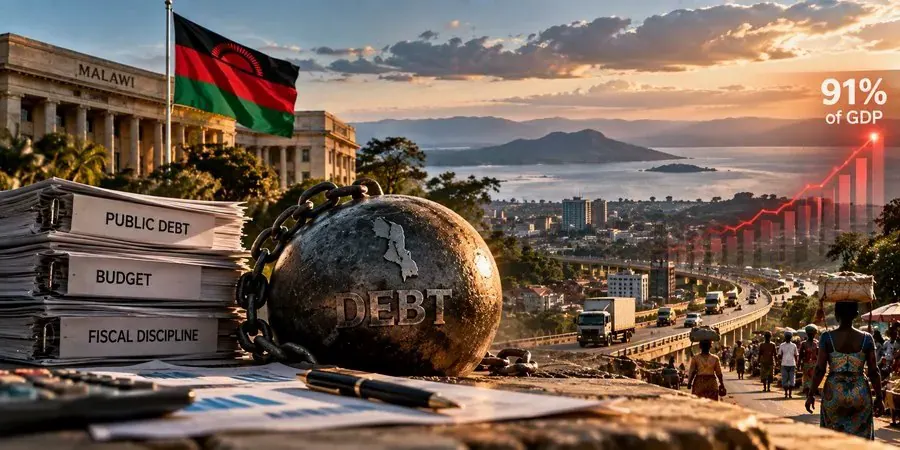
Malawi's fiscal discipline has become a focal point for investors as the country's public debt approaches 91% of GDP. The Economics Association of Malawi (Ecama) reports that public debt stands at approximately K24 trillion. This figure has raised alarms among economists and development-finance observers, who emphasize the need for urgent spending restraint and foreign-exchange reform. Macroeconomic stability is now Malawi's defining policy challenge.
Ecama is urging the government to reduce its fiscal deficit and control expenditure to mitigate the risks associated with high public debt. The association recommends lower domestic borrowing and tighter accountability at state-owned enterprises. According to Ecama, heavy government borrowing has crowded out private-sector credit and weakened financial intermediation. Elevated non-performing loans further compound the problem, constraining bank lending and limiting access to credit for private businesses.
Reducing public borrowing is crucial to easing pressure on the financial system and creating space for private investment. However, spending cuts carry a direct cost for businesses that rely heavily on government contracts. Bertha Bangara-Chikadza, Ecama's president, noted that contractionary fiscal policy can narrow the deficit but simultaneously damage businesses reliant on government spending. This trade-off will shape the government's policy decisions in the coming months.
Despite the challenges, there are signs of cautious optimism. World Bank data show that Malawi's overall deficit narrowed to 8.8% of GDP in the 2025/26 financial year, compared with an average of 10.7% over the previous three years. This improvement signals that fiscal consolidation is already underway, which could help restore investor confidence and pave the way for economic recovery.
Ecama is also pressing for greater exchange-rate flexibility and action against parallel-market distortions. A more flexible official rate would reduce the gap between formal and informal foreign-exchange markets, improving dollar access for companies currently shut out of official channels. However, this adjustment carries near-term costs, including higher import prices and potential margin pressure for import-dependent firms.
The sequence of reforms will be critical to Malawi's economic recovery. Authorities must contain borrowing, protect essential spending, and correct currency-market distortions without deepening the economic slowdown. Progress on each front will reinforce the others, and investors will be closely monitoring budget execution data, domestic borrowing volumes, and any shift in official exchange-rate policy in the months ahead.
Sovereign risk assessments will also respond to reform progress at state-owned enterprises, a sector where fiscal slippage has historically been hardest to contain. Malawi's policy reset will be judged by whether fiscal restraint restores foreign-exchange access and promotes sustainable economic growth. The coming months will be crucial in determining the country's economic trajectory and its ability to address the challenges posed by high public debt.
Key points
- Malawi's public debt stands at approximately 91% of GDP, sparking concerns among economists and investors.
- Ecama is urging the government to reduce its fiscal deficit and control expenditure to mitigate the risks associated with high public debt.
- A more flexible official exchange rate could improve dollar access for companies and promote economic recovery.