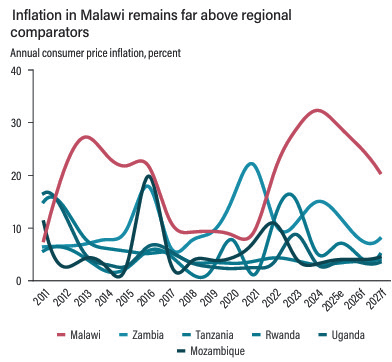
A research firm, Business Monitor International (BMI), has warned that Malawi's inflation could accelerate in the coming months, further straining household incomes and consumer spending. Although headline inflation decreased from 24.9 percent in January to 20 percent in August, BMI expects price pressures to intensify. The firm's concerns are rooted in the widespread use of the parallel foreign exchange market, which has driven up the actual cost of imported goods beyond official prices.
The cost of non-food items in Malawi has risen significantly, with a 30.65 percent increase from K233,905 to K305,607 between January and June 2026, according to the Employers Consultative Association of Malawi (Ecam). This surge contributed to a 9.73 percent rise in transport costs to K1.129 million from K1 million, despite a decline in food prices during the same period. These trends have raised concerns about the impact on household incomes and consumer spending.
The National Statistical Office reported that year-on-year headline inflation averaged 23.6 percent in the first half of 2026, down from 28.9 percent over the same period last year. However, the Reserve Bank of Malawi (RBM) has cautioned that rising non-food inflation and domestic fuel price adjustments could undermine the easing inflation trend, despite lower food inflation. The RBM projects annual inflation at 24.8 percent, down from 28.4 percent in 2025.
Centre for Social Concern programme officer for economic governance Agnes Nyirongo stated that volatile transport costs, driven by foreign exchange shortages, are affecting both businesses and households. She noted that high inflation is not only straining households but also stifling business growth. Rising production and transport costs are being passed on to consumers, further fuelling inflation in a vicious cycle.
RBM Deputy Governor for operations Kisu Simwaka argued that single-digit inflation is achievable with effective policy coordination between the central bank and government. He emphasized that inflation control requires a central bank with operational independence, a government exercising fiscal discipline, adequate foreign exchange buffers, reduced dependence on imports, and policy credibility.
University of Malawi economics lecturer Edward Leman noted that future inflation trends will depend on domestic food supply, as well as global fuel prices and exchange rate stability. He expressed cautious optimism, citing that Malawi's inflation is predominantly food-driven and a favourable agricultural season could help ease pressures.
BMI forecasts real gross domestic product growth to slow from an estimated 2.5 percent in 2025 to 1.7 percent in 2026 before recovering modestly to 1.9 percent in 2027, with weak private consumption remaining the main constraint. The firm's warning comes as authorities seek a new International Monetary Fund programme, which may involve devaluing the kwacha.
Key points
- Malawi's inflation may accelerate due to the parallel foreign exchange market and potential kwacha devaluation.
- The cost of non-food items has risen significantly, contributing to increased transport costs.
- Single-digit inflation is achievable with effective policy coordination between the central bank and government.