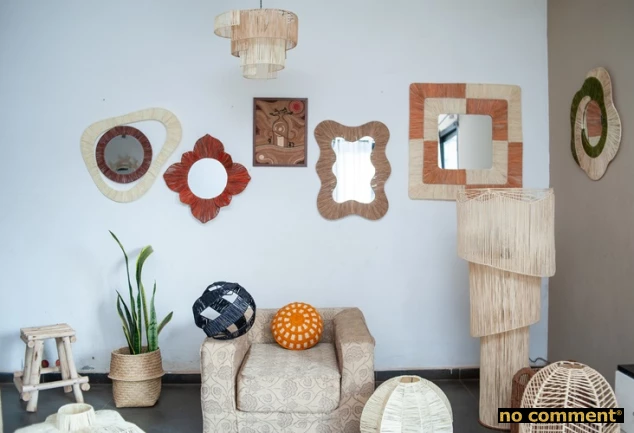
In his Ambohijanaka workshop, Tolotra is revolutionizing the use of raphia fiber, a natural material traditionally used for making baskets and bags. With his brand Raphia Ladina, he is creating decorative pieces that blend traditional techniques with modern design. Tolotra's goal is to show that raphia can be used in home decor and give it a new dimension. His designs are inspired by current trends, including spiral mirrors that are very popular on social media.
Tolotra's creative process begins with a drawing on paper, followed by a metal structure made with a welding artisan. The raphia fiber is then woven, or "trandana" and "landina", to give texture and character to the piece. Some models take on a sculptural dimension, with flower-shaped mirrors featuring petals that protrude from the frame in relief, accompanied by large worked leaves at the back. The attention to detail is meticulous, with each piece requiring patience and skill.
Tolotra is aware of the risk of counterfeiting and constantly updates his designs to stay ahead. He prefers to keep creating and changing his designs regularly, rather than resting on his laurels. This approach allows him to stay innovative and protect his unique creations. His strategy seems to be working, as his workshop now employs around six people and his creations are in demand.
The price of Tolotra's creations varies depending on the complexity of the design, but they start at around 80,000 ariary. One of his most notable pieces is a large, two-meter by three-meter mirror with a spiral border made entirely of raphia, which took a week to create and cost 500,000 ariary. This piece showcases the potential of raphia fiber when used creatively and skillfully.
Raphia Ladina currently focuses on the local market, with orders placed through Facebook and the possibility of custom-made pieces. Tolotra's vision is to create a space where his creations can be displayed in a way that feels like a warm and welcoming atmosphere. He imagines a room with a raphia mirror, soft lighting, and a bookshelf, where his pieces can be appreciated as part of a larger aesthetic.
Tolotra's ultimate goal is to promote the value of local creations and show that traditional techniques can be combined with modern design to create something unique and beautiful. He believes that by supporting local artisans and designers, Malagasy people can appreciate the beauty and craftsmanship of their own culture. His passion for his craft is evident in every piece he creates.
With Raphia Ladina, Tolotra is not only creating stunning decorative pieces but also contributing to the preservation and promotion of Malagasy culture. His innovative approach to traditional materials is inspiring a new generation of designers and artisans to explore the possibilities of local materials. As his brand continues to grow, Tolotra remains committed to his vision of showcasing the beauty and versatility of raphia fiber.
Key points
- Tolotra's use of raphia fiber in home decor is a game-changer for the industry.
- Raphia Ladina's unique designs are a blend of traditional techniques and modern style.
- Tolotra's goal is to promote the value of local creations and support Malagasy artisans.