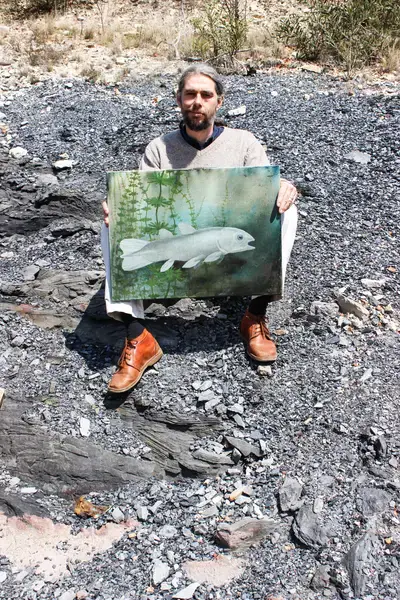
The International Union of Geological Sciences (IUGS) has officially recognised Waterloo Farm, located just outside Makhanda, as a global Geological Heritage site. This declaration was presented at a global conference in Monchique, Portugal, and honours nearly four decades of groundbreaking palaeontological discoveries at the 365-million-year-old site. The site represents the world's only window into a high-latitude Late Devonian ecosystem.
The recognition marks another milestone in a lifetime of discoveries by researcher Dr Rob Gess, who has spent almost 40 years investigating the ancient deposits. The Waterloo Farm fossils date back to the Late Devonian period, when the land that would eventually become the Eastern Cape formed part of the ancient southern supercontinent of Gondwana, close to the South Pole. At that time, the area was a coastal estuarine environment, home to an extraordinary diversity of fish, early four-legged vertebrates, plants, and other organisms.
What makes Waterloo Farm particularly important is that it provides the world's only comprehensive record of a Late Devonian estuarine ecosystem from such a high-latitude, or circumpolar, setting. Most other significant fossil deposits from this period represent environments much closer to the ancient equator. Discoveries at Waterloo Farm have provided evidence of life in a part of the prehistoric world about which very little was previously known.
Among the most important finds are fossils of two early tetrapods, animals belonging to the evolutionary group that eventually gave rise to modern amphibians, reptiles, birds, and mammals. The two species, Tutusius umlambo and Umzantsia amazana, were described by Gess and Swedish palaeontologist Prof Per Ahlberg in the international scientific journal Science in 2018. One of the species, Tutusius umlambo, was named in honour of Archbishop Emeritus Desmond Tutu.
Another extraordinary discovery was the world's oldest known fossil lamprey, Priscomyzon riniensis. Lampreys are primitive, jawless fish whose ancestors provide important clues to the early evolution of vertebrates. Specimens recovered from Waterloo Farm include individuals at different stages of development, from newly hatched young to adults. These fossils have provided scientists with unusually detailed evidence of how ancient lampreys developed.
Waterloo Farm has also yielded the world's earliest known coelacanth nursery. Coelacanths are an ancient group of lobe-finned fish, once believed to have become extinct millions of years ago until a living specimen was caught off the Eastern Cape coast in 1938. The discovery of numerous juvenile coelacanth fossils at Waterloo Farm provided evidence that the ancient estuary served as a breeding and nursery habitat for these fish.
The discoveries have been the result of decades of painstaking work, much of it involving the careful examination of shale recovered during road construction. So far, 28 species have been scientifically described and named, though Gess says this represents less than half of the plants and creatures known from fossils at Waterloo Farm. The site's unique geographical position and exceptional preservation of fossils have made it a treasure trove of scientific information.
Key points
- The International Union of Geological Sciences has recognised Waterloo Farm in Makhanda as a global Geological Heritage site.
- The site provides a unique window into a high-latitude Late Devonian ecosystem.
- Discoveries at Waterloo Farm have included early tetrapods, ancient lampreys, and the earliest known Gondwanan terrestrial animal.