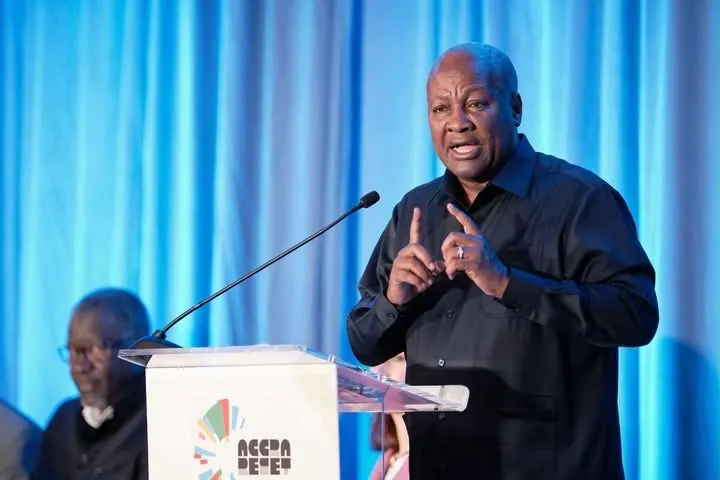
At the 81st UN General Assembly, President John Dramani Mahama of Ghana delivered a strong message, emphasizing that African countries cannot truly own their health systems if foreign donors control funding and medicine supply. He launched a new report, 'A Sovereign Future for Health,' which aims to restructure global health cooperation. The report was produced under the Accra Reset initiative, which seeks to reposition Ghana's approach to foreign aid and governance. Mahama's statement marked a year since the Accra Reset began.
The report proposes that global health cooperation be restructured around stronger national and regional capacity, greater domestic ownership of health financing, and partnerships with international institutions that come with clearer accountability. Mahama argued that the commonly used idea of "country ownership" in international development often means little more than handing African governments responsibility for programs without giving them real control over resources or decisions. He used a striking image to describe the situation, saying countries have been given a broken pot and told to own a soup cooked entirely in someone else's kitchen.
Mahama tied the launch of the report to the one-year anniversary of the Accra Reset, a framework his government has used to reposition Ghana's approach to foreign aid and governance. He said the Accra Reset had rejected the notion that the health, dignity, and future of Ghanaians should remain permanently tethered to donor goodwill. Mahama emphasized that sovereignty is a two-way obligation, and countries like Ghana must earn greater control over their health financing through strict domestic accountability, including tighter fiscal management and a sustained fight against corruption.
The report calls for a country-led "one-stop" health compact, a shift toward sustainable domestic financing, stronger regional health institutions, coordinated regional drug procurement, and independent tracking of whether governments and donors keep their promises. Mahama singled out maternal mortality in sub-Saharan Africa as the first area of focus, pointing to initiatives such as Mother Africa and Business United for Mothers, Babies and Youth (BUMBY) as vehicles for turning the report's commitments into direct support for women, children, and young people.
The proposals, if pursued, would affect how Ghana's hospitals and health programs are funded and how medicines reach patients over the longer term. The report does not call for donor funding to be cut off immediately; instead, it proposes a managed transition in which external support continues to protect essential services while countries build up their own capacity. Mahama thanked former Nigerian President Olusegun Obasanjo, former Liberian President Ellen Johnson Sirleaf, former Costa Rican President Laura Chinchilla, and the panel's co-chairs for their work on the report.
According to the report's timeline, independent follow-up mechanisms to track progress are meant to begin within six months, while country-led health compacts are expected to be developed within 12 months. No further dates for Ghana-specific implementation have been given. This development follows Ghana's build-up to the General Assembly, where Mahama pushed the Accra Reset agenda. The initiative includes building up local industrial capacity, particularly in pharmaceuticals, so that Ghanaian manufacturers can produce essential medicines locally.
The launch of the report and Mahama's address at the UN General Assembly highlight the need for a new approach to global health cooperation. The Accra Reset initiative and the report's proposals aim to create a more equitable and sustainable health system in Ghana and other African countries. The emphasis on domestic accountability and sovereignty is expected to resonate with other countries in the Global South.
Key points
- Mahama calls for real control over health systems
- The report proposes a managed transition to domestic financing
- The initiative includes building local industrial capacity in pharmaceuticals