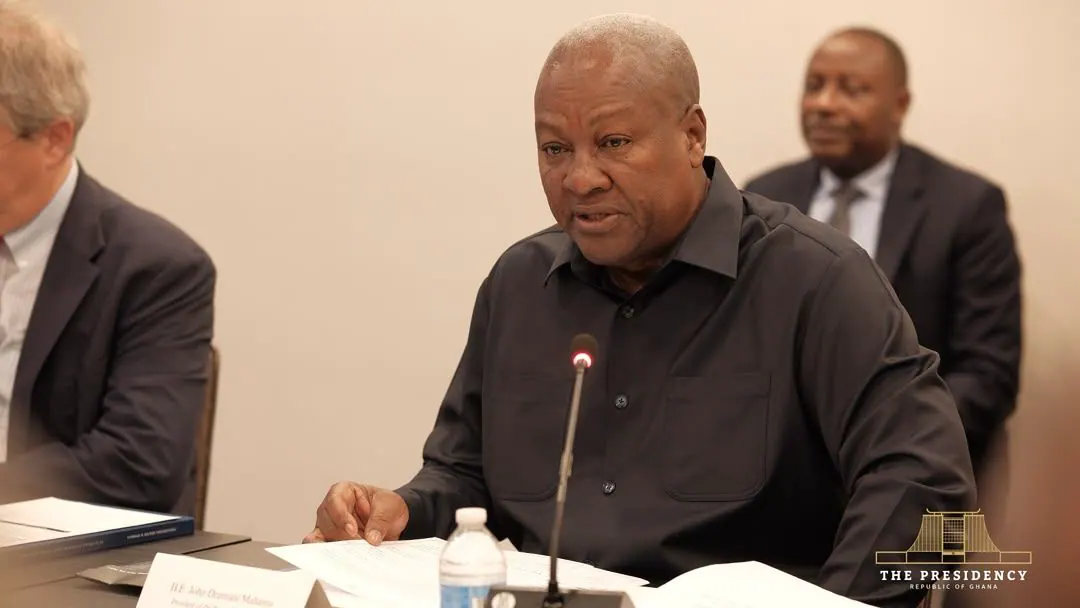
Former President of Ghana, John Dramani Mahama, has emphasized the need for expanded opportunities for young people in the face of global disruption. Speaking at a presidential roundtable organised by the Open Society Foundation in New York on the sidelines of the 81st UN General Assembly, Mahama argued that despite turmoil and challenges, opportunities for innovation and reform remain. The roundtable brought together presidents and chief executives of major global foundations. Mahama's remarks highlight the urgent need for strategic actions to address the pressing issues facing countries in the Global South.
According to Mahama, the international development landscape is rapidly evolving, with the global order facing severe disruption as countries in the Global South contend with mounting debt pressures. He stressed that in the midst of disruption and chaos, new ideas and partnerships are born. Mahama emphasized that this is a critical moment for creating jobs, improving public services, building infrastructure, and expanding opportunities, especially for young people. His comments underscore the imperative for countries like Ghana to strengthen their ability to pursue these priorities with greater confidence and continuity.
Mahama noted that Africa has already defined its long-term strategic pathway through Agenda 2063, a framework focused on building productive economies, robust institutions, deeper regional integration, expanded opportunities, and a stronger African voice in global affairs. He stressed that the continent's leaders must immediately strengthen the institutions, financing capabilities, and delivery systems needed to achieve these ambitions. This, according to Mahama, will enable Africa to effectively pursue its priorities and drive sustainable development.
The former President also touched on the "Accra Reset" Initiative, which addresses what nations need to act with greater urgency and self-reliance in a shifting global context. He explained that the initiative seeks to define what a more balanced relationship with international partners could look like. Mahama emphasized the importance of sovereignty in this context, which he described as the capacity to act. He noted that a country needs to be able to set its priorities, negotiate effectively, mobilise resources, and follow through on its decisions.
Mahama acknowledged that Ghana still has significant progress to make to exercise full ownership over its development trajectory. He identified areas for improvement, including stronger coordination across government, better preparation of programs and projects, greater domestic resource mobilisation, sound financial management, and institutions that can demonstrate clear results. Mahama also stressed the need to leverage capabilities outside government, including civil society, business, academia, and local communities.
Mahama urged international partners and philanthropic organisations to shift from short-term programmes to long-term capability building. He asked if international cooperation can do more to build national capability and work through local systems when they meet required standards. Mahama also called on foundations to use their unique flexibility to fund public goods and institutional capacity where commercial finance cannot. He highlighted the vital role of philanthropy in health, education, governance, and research across Africa.
In conclusion, Mahama emphasized the need for a more strategic and sustainable approach to development. He called on foundations to support institutional capability, early programme development, public goods, and social priorities. Mahama also stressed that where an approach proves successful, the next step should be its adoption into public systems, local delivery institutions, and long-term financing models. This, according to him, will ensure sustainability and maximise impact.
Key points
- Mahama calls for expanded opportunities for youth amid global disruption.
- Africa's leaders must strengthen institutions, financing capabilities, and delivery systems to achieve Agenda 2063 ambitions.
- Mahama urges international partners to shift from short-term programmes to long-term capability building.