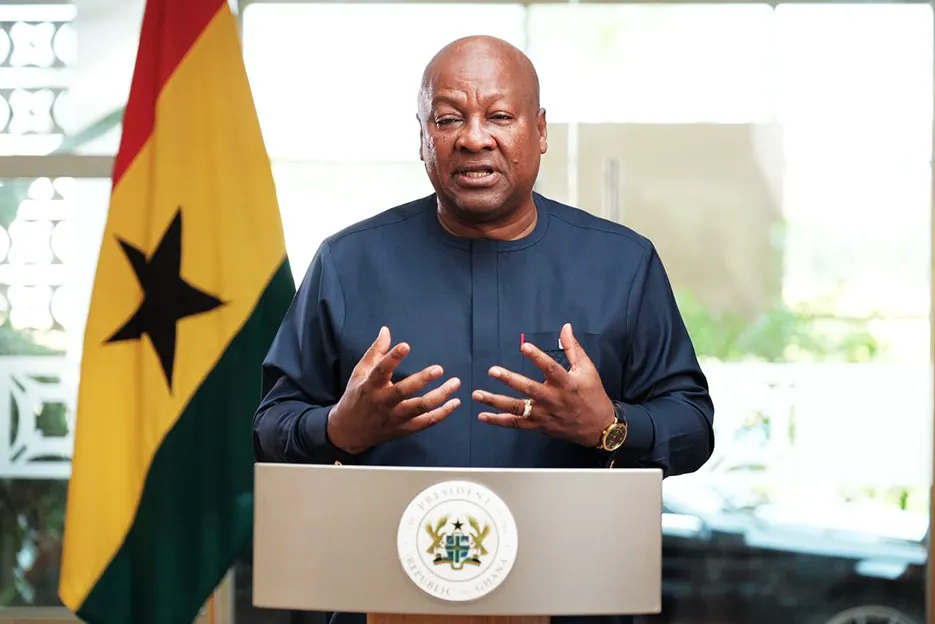
President John Dramani Mahama of Ghana has urged developing countries to reduce their reliance on foreign aid, emphasizing the need for greater self-sufficiency to strengthen national sovereignty. Speaking at a high-level event in New York, he launched a report aimed at transforming global health governance and promoting self-reliance in the Global South. The report, compiled by a panel of the Accra Reset, marks a significant milestone in the broader Accra Reset Agenda. Mahama highlighted the ongoing impact of structural inequalities on the sovereignty of Global South nations.
Mahama noted that despite achieving political independence decades ago, African countries still face significant challenges due to structural inequalities in the global system. He emphasized that the levers of global trade, finance, and health governance remain controlled by external powers. The President cited Ghana's domestic initiatives, such as efforts towards local value addition, healthcare investments, and the 24-hour economy, as reflecting the core objectives of the Accra Reset initiative. These initiatives aim to promote self-reliance and reduce dependence on foreign aid.
The report, titled "A Sovereign Future for Health," outlines a roadmap for transitioning from policy design to immediate execution. It focuses on building domestic industrial capacity, expanding local pharmaceutical manufacturing, and establishing state-guaranteed purchasing arrangements to strengthen medicine supply chains across Africa and Asia. Mahama stressed that the Accra Reset initiative is not intended to isolate the Global South from international partners but rather to promote "pragmatic interdependence" based on equal terms.
Mahama emphasized that stronger, self-reliant Southern partners are not a threat to the Global North. Instead, resilient health systems in Africa and Asia make the entire world safer for all. He rejected traditional aid models that provide limited local oversight, outlining a new doctrine for future development. This doctrine is based on the principles of ownership, control, and accountability, with Mahama stating, "No ownership without control, and no control without absolute accountability."
The launch event attracted prominent international figures, including former Nigerian President Olusegun Obasanjo, Prime Minister of Barbados Mia Mottley, UN Under-Secretary-General Amina Mohammed, President William Ruto of Kenya, and billionaire Aliko Dangote. Mahama's call for self-reliance resonated with the audience, who recognize the need for a more equitable global system. The event highlighted the growing momentum behind the Accra Reset initiative and its potential to reshape global health governance.
Looking ahead, President Mahama announced that Ghana will seek to push the transformative agenda of the Accra Reset to the forefront of continental policy when the country assumes the Chairmanship of the African Union in 2027. This move is expected to amplify the initiative's impact and promote a more self-reliant and equitable Global South. Mahama's leadership on this issue is seen as a significant step towards achieving a more balanced global system.
The Accra Reset initiative has gained significant attention in recent months, with many experts hailing it as a bold move towards promoting self-reliance and reducing dependence on foreign aid. As the Global South continues to navigate the complexities of global governance, Mahama's call for self-reliance and pragmatic interdependence is likely to remain a key theme in international discussions. The initiative's success will depend on the commitment of Global South nations to work together towards a more equitable and self-sufficient future.
Key points
- President Mahama calls for self-reliance in Global South nations
- Accra Reset initiative aims to reshape global health governance
- Ghana to push Accra Reset agenda at African Union in 2027