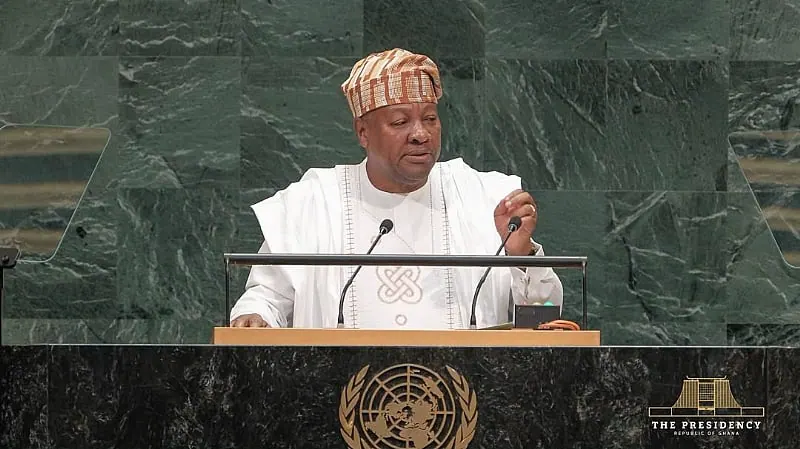
On September 24, 2026, President John Dramani Mahama addressed the 81st United Nations General Assembly, echoing the legacy of Ghana's first president, Kwame Nkrumah. In his speech, Mahama emphasized the importance of unity, justice, and equality, highlighting the need for a permanent seat with veto power for Africa on the United Nations Security Council. He also demanded climate justice for countries like Ghana, which suffer greatly from the effects of climate change. Furthermore, he called for an end to the collective punishment in Gaza, which has resulted in thousands of lives lost.
Earlier in the year, on March 25, 2026, Mahama's government tabled Resolution A RES 80 250 at the United Nations, which was agreed upon by 123 countries, recognizing the trans-Atlantic slave trade as the gravest crime against humanity. In his UNGA speech, Mahama reminded the world that justice must follow this recognition. Domestically, Mahama's government has made efforts to improve healthcare, increasing domestic health financing to 72% of total health spending in 2026, up from 56.8% in 2023. The total financing for healthcare is 34.7 billion cedis, including the National Health Insurance Scheme (NHIS).
The President announced innovative ideas, such as the Free Primary Healthcare and the Ghana Medical Trust Fund, dubbed MahamaCares, aimed at covering chronic diseases like cancer, kidney failure, and heart disease. MahamaCares also provides 500 cedis support for dialysis in private hospitals. The World Health Organization (WHO) has praised this initiative as a good example for the Global South. However, implementation gaps remain, with reports of hospitals billing for medicines not provided and taking illegal money from NHIS cardholders.
Human rights and freedom of expression are concerns in Ghana, despite being a beacon of democracy. The Media Foundation for West Africa (MFWA) documented 14 arrests linked to speech laws within the first 16 months of the current National Democratic Congress (NDC) administration, compared to 8 arrests in the entire 8 years of the previous New Patriotic Party (NPP) government. The Foundation warns of the weaponization of Section 76 of the Electronic Communications Act. This is concerning, given that then-candidate Mahama in 2022 warned against using state power to intimidate dissent.
On September 23, 2026, just a day before Mahama's UNGA speech, the Economic and Organised Crime Office (EOCO) attempted to arrest a Member of Parliament inside the Accra High Court complex while he was representing a client. The Ghana Bar Association (GBA) condemned the attempt, stating that arresting lawyers while doing their work must follow due process. Additionally, Professor Kwadwo Appiagyei-Atua warned in August 2026 that academic freedom is declining across Africa, with restrictions on expression and political interference.
Education is another area where access without equity is incomplete. The Big Push for schools and digital connectivity is commendable, but current events are worrisome. At Asamankese on September 15, 2026, the Eastern Regional Coordinator for Free Senior High School said that being an NDC member or executive could help secure school placement, amidst over 55,000 children without placement. Amnesty International notes that human rights education receives minimal attention, and the Ghana National Association of the Deaf highlights that deaf students face barriers in accessing education.
Climate change and the economy are also critical areas where Ghana demands action outside and must do inside. Mahama demanded climate justice at the United Nations, citing 160 millimeters of rain in one day in seven regions. However, in June 2026, Ghana recorded 593.2 millimeters for the month, the highest since 1995, with 169.2 millimeters in one day, resulting in 12 deaths in Accra alone and 34 nationwide. The Greater Accra Resilient and Integrated Development (GARID) project, aimed at fixing Accra floods, had no funding for 16 months.
Key points
- President Mahama calls for a permanent seat with veto power for Africa on the United Nations Security Council
- Mahama's government increases domestic health financing to 72% of total health spending in 2026
- Concerns rise over human rights and freedom of expression in Ghana despite being a beacon of democracy