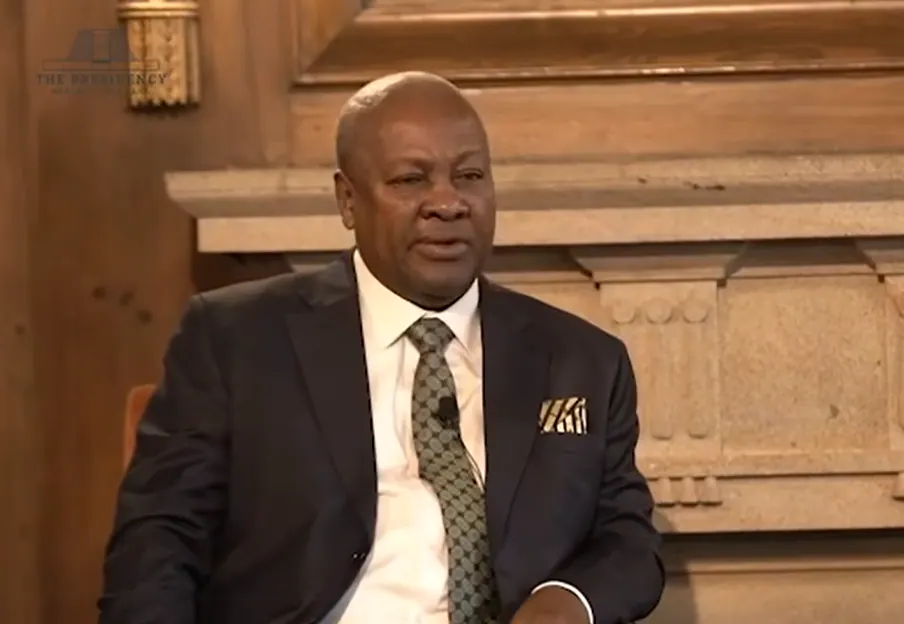
Former President John Dramani Mahama has disclosed that Ghana's Cabinet rejected a US health compact due to several contentious provisions. Speaking at the Council on Foreign Relations in New York on September 25, 2026, Mahama revealed that the Health Ministry had studied the compact, which aimed to replace funding lost when USAID support ended. The Ministry prepared a Cabinet Information Paper, highlighting concerns that led to the compact's swift rejection.
Mahama explained that the compact required Ghana to hand over its pathogen profile, which he described as a list of diseases endemic in the country. He questioned the rationale behind such a demand, suggesting that medical experts would better understand its implications. The compact also demanded Ghana's medical records, which Mahama found hard to comprehend, wondering who would take another country's medical records.
The agreement had further conditions that Mahama described as "humiliating." Ghana was required to contribute a certain amount of money towards the program and allow the Food and Drugs Authority (FDA) to be barred from inspecting medicines or medical products brought into the country under the compact. These conditions led to the Cabinet's swift rejection of the document.
Mahama emphasized that the Cabinet had never acted so quickly to reject any proposal, stating that it was thrown out in record time. The Health Minister was subsequently asked to inform the US Ambassador that Ghana did not need the compact. This decision was made to protect Ghana's interests and sovereignty.
The US health compact was offered to Ghana as a replacement for funding that was lost when USAID support ended. However, the conditions attached to the compact were deemed unacceptable by the Ghanaian government. Mahama's revelation provides insight into the reasons behind the rejection, highlighting the importance of national sovereignty and data protection.
The rejection of the compact has significant implications for Ghana's healthcare sector, which may need to explore alternative funding sources. The country's healthcare system may face challenges in the absence of USAID support, and the government may need to consider other partnerships or funding options.
Mahama's comments on the rejected compact have sparked a national conversation about Ghana's healthcare sector and its partnerships with international organizations. The incident highlights the need for careful consideration and negotiation of international agreements to ensure that they align with national interests and priorities.
Key points
- Ghana's Cabinet rejected a US health compact due to demands for pathogen profiles and medical records.
- The compact's conditions were deemed "humiliating" by Mahama, including a ban on FDA inspections.
- The rejection highlights the importance of national sovereignty and data protection in international agreements.