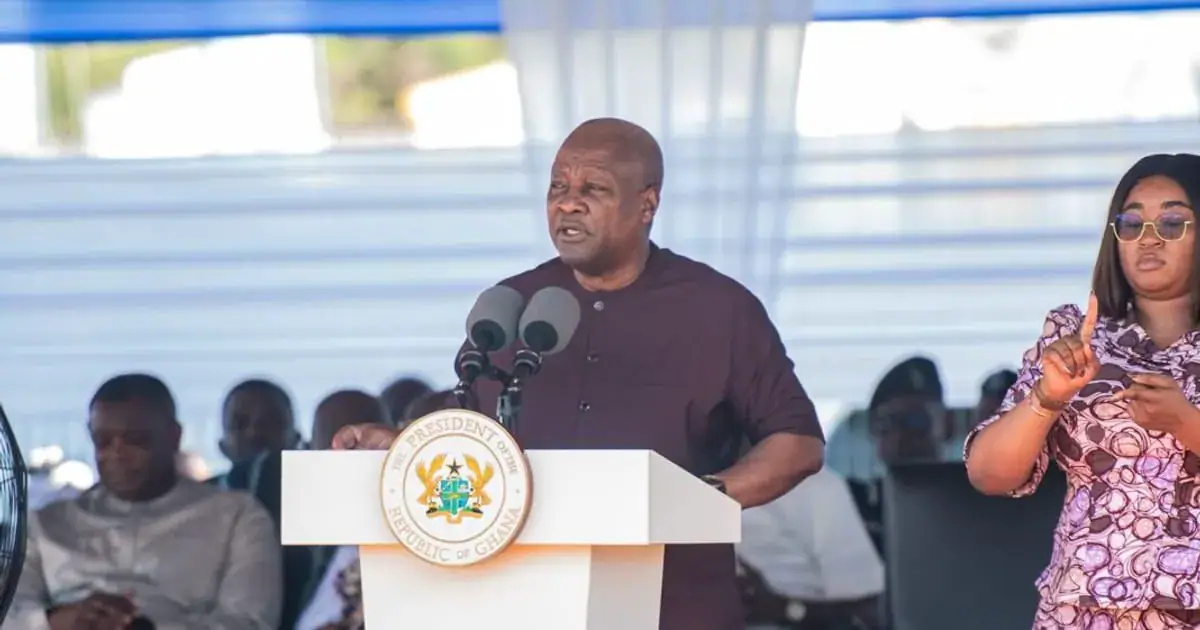
President John Dramani Mahama has announced plans to invest more than US$9 billion in job-creating sectors between 2027 and 2030 under the government's proposed “New Economy” policy. The full blueprint will be laid before Parliament when Finance Minister Dr Cassiel Ato Forson presents the 2027 Budget Statement and Economic Policy on Thursday, November 12. Mahama said the next phase of his administration's economic agenda will focus on helping citizens secure decent and dignified livelihoods.
Mahama made the announcement at the grand durbar of the 2026 Hogbetsotso Festival in Anloga on Saturday, November 7. He said the Volta Region is lined up to benefit from targeted investments under the proposed policy, naming textiles, garments, commercial agriculture, hospitality and tourism as priority areas selected for their capacity to generate jobs. The President told the gathering that the Volta Region is expected to benefit greatly under the New Economy policy.
The proposed New Economy policy is a bold initiative that will seek to invest over $9 billion in job-rich sectors of the economy between 2027 and 2030. In October, during a meeting with Western North chiefs, Mahama had described a broader five-year US$10 billion New Economy framework allocating about US$2 billion annually across nine productive pillars — including pharmaceuticals, agribusiness, textiles and tourism — without new borrowing.
Policy think tank the Institute for Economic Research and Public Policy (IERPP) has called on the government to publish the proposed programme's financing structure, investment criteria and sector allocations in the upcoming budget. The think tank's request comes as the government prepares to present the 2027 Budget Statement and Economic Policy.
At the local government level, Mahama also pointed to ongoing district projects — health facilities, classroom blocks and feeder roads — financed through the District Assemblies Common Fund (DACF). He credited a directive he issued after taking office requiring that at least 80 per cent of DACF releases be sent directly to district assemblies.
Finance Minister Dr Cassiel Ato Forson says the government intends to use the New Economy programme to push Ghana toward an investment-grade sovereign credit rating to reduce borrowing costs and help local companies raise long-term capital. Forson noted that Ghana's domestic bond market largely ground to a halt in 2022 and local banks lost access to credit lines after the sovereign debt default and the Domestic Debt Exchange Programme.
An investment-grade rating would bring government bonds within reach of institutional investors restricted to higher-rated debt while deepening the domestic corporate bond market so businesses can finance equipment and expansion. Forson said reaching that goal requires keeping the economy stable and predictable, adding that the New Economy must also deliver household financial security for Ghanaians.
Key points
- The 'New Economy' plan aims to invest US$9 billion in job-rich sectors between 2027 and 2030.
- The plan focuses on sectors such as textiles, garments, commercial agriculture, hospitality and tourism.
- The goal is to push Ghana toward an investment-grade sovereign credit rating.