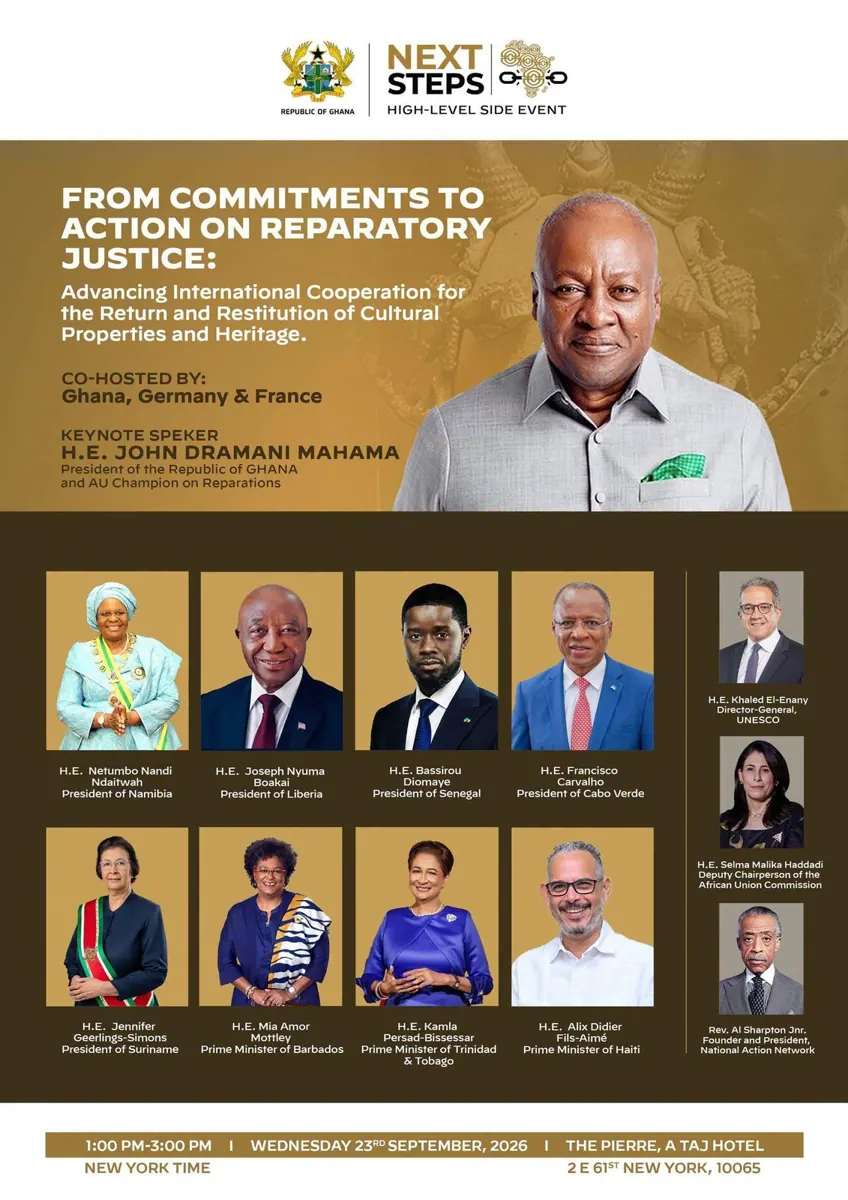
Leaders from Ghana, Barbados, and Liberia converged on a UN General Assembly side event in New York, calling on the international community to move beyond apologies and take concrete actions on reparatory justice for the transatlantic slave trade. The event, co-hosted by Ghana, Germany, and France, took place on September 23, 2026, at The Pierre Hotel. Ghana's President John Dramani Mahama, Barbados Prime Minister Mia Mottley, and Liberian President Joseph Boakai were among the prominent attendees. The gathering aimed to build on a UN General Assembly resolution adopted six months prior, recognizing the slave trade as the gravest crime against humanity.
The UN General Assembly resolution, passed on March 25, 2026, was backed by 123 member states, with 56 countries abstaining and three voting against. This resolution marked a significant milestone, as it was the first time the world body had used such unequivocal language to describe the centuries-long trade in enslaved Africans. For advocates of reparatory justice, this development strengthens the legal and moral basis for African and diaspora nations to press former colonial and slave-trading powers for restitution, cultural returns, and institutional redress.
The New York event built directly on Ghana's High-Level Next Steps Conference on Reparatory Justice, held in Accra from June 17 to 19, 2026. This conference drew government officials, scholars, legal experts, civil society groups, and members of the African diaspora, producing the Accra Next Steps Commitments on Reparatory Justice. The commitments outlined a roadmap for stronger international legal cooperation, cultural restitution, historical truth-telling, and deeper engagement with Africans in the diaspora.
During the Accra meeting, President Mahama announced three global mechanisms to carry the agenda forward: a High-Level Advisory Council on Reparatory Justice, a Global Experts Panel on the Restitution of Cultural Heritage, and a Global Legal Panel on Reparatory Justice. The New York event featured panels reporting on the progress these bodies have made since June. The gathering was attended by several heads of state, including the presidents of Namibia, Senegal, Cabo Verde, and Suriname, as well as Prime Ministers Kamla Persad-Bissessar of Trinidad and Tobago and Alix Didier Fils-Aimé of Haiti.
UNESCO Director-General Khaled El-Enany and African Union Commission Deputy Chairperson Selma Malika Haddadi were also among the participants. The side event was one of several diplomatic pushes made by Ghanaian officials on the fringes of the 81st United Nations General Assembly. Around the same period, Foreign Minister Samuel Okudzeto Ablakwa was courting Gulf states to fund Ghana's railway network, while Mahama separately positioned MiDA as Ghana's single gateway for global philanthropic funding.
For Ghana, the reparatory justice campaign carries both symbolic and practical weight. The UN resolution strengthens the country's position in pressing for restitution, cultural returns, and institutional redress. However, ordinary Ghanaians have not yet been informed about the direct benefits that might flow from the reparations push. The sources do not specify a timeline for when the three global panels are expected to deliver concrete recommendations or when restitution talks might translate into agreements.
The UN General Assembly is the main deliberative body of the United Nations, where all 193 member states can vote on resolutions, though such resolutions are generally not legally binding. Reparatory justice, as used by Ghana and its partners, refers to a mix of financial compensation, cultural restitution, and institutional reforms sought as redress for historical slavery and colonialism. The campaign's progress and outcomes will likely have significant implications for Ghana and other nations advocating for reparatory justice.
Key points
- The UN General Assembly adopted a resolution recognizing the slave trade as the gravest crime against humanity on March 25, 2026.
- Ghana, Barbados, and Liberia's leaders joined a UN event demanding action on reparatory justice on September 23, 2026.
- The reparatory justice campaign for Ghana carries both symbolic and practical weight, strengthening the country's position in pressing for restitution and institutional redress.