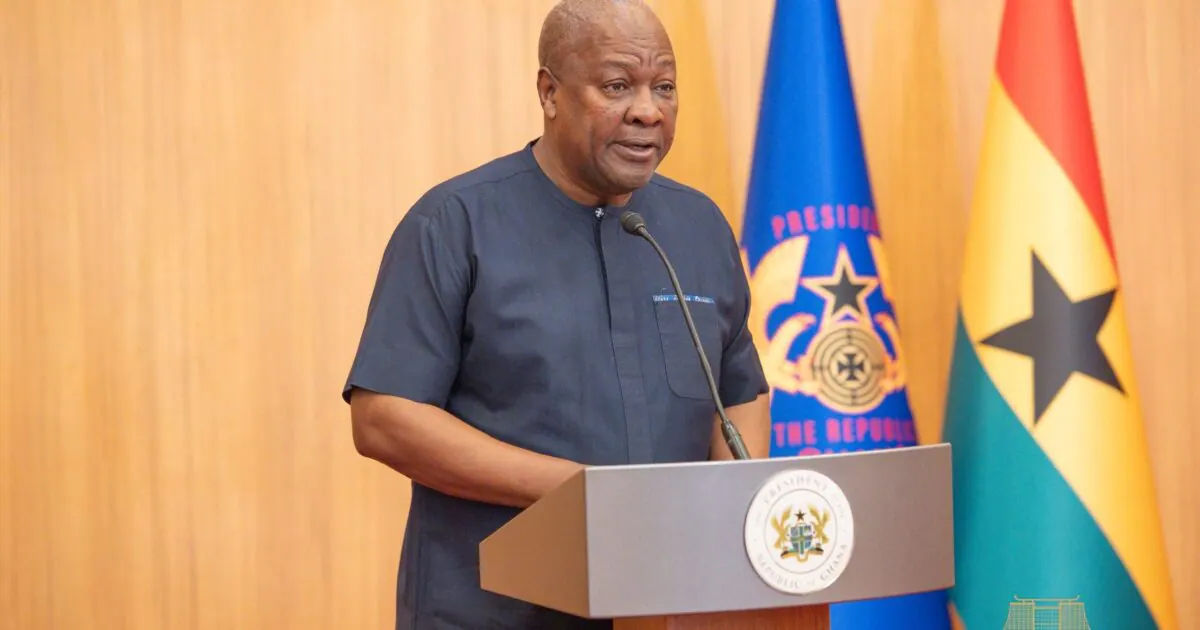
Former Ghanaian President John Mahama has stated that the struggle for control of Africa's natural resources and the profits from their extraction are central to the continent's security crises. He made this statement at the 12th Tana High-Level Forum on Peace in Africa in Bahir Dar, Ethiopia. According to President Mahama, powerful interests benefit from prolonged instability in Africa. He emphasized that Africa risks remaining vulnerable if its leaders fail to take greater control of their resources and determine their own security priorities.
President Mahama stressed that Africa should not be an empty chessboard for foreign powers to play their games, and that the continent's leaders must take charge of their own destiny. He noted that Africa's importance in the global green energy transition and digital economy should give the continent greater bargaining power. However, communities endowed with these resources often bear the consequences of exploitation without enjoying the benefits. President Mahama argued that sovereignty must go beyond political independence and membership of international institutions.
The former Ghanaian President emphasized that real sovereignty means having the administrative, legal, and economic power to govern strategic assets, negotiate fair terms, and ensure that the wealth beneath the people's feet actually puts food on their tables. He added that anything less amounts to "cosmetic independence that masks economic subjugation." President Mahama challenged African leaders to examine who controls natural resources, who benefits financially from their extraction, and whose political and financial interests are better served by continued instability than lasting peace.
President Mahama cited Sudan, the Democratic Republic of Congo (DRC), Somalia, and Mozambique as examples of how resource competition, governance failures, and economic marginalization contribute to insecurity. In Sudan, he said the battle lines were drawn as much around gold extraction sites as around Khartoum. In eastern DRC, he linked the resurgence and entrenchment of the M23 group to coltan, cobalt, and the global competition for minerals needed for the green energy transition.
The former Ghanaian President also attributed the continued presence of Al-Shabaab in Somalia partly to governance failures that have created openings for the group to exploit. In Mozambique's Cabo Delgado region, he said the area's substantial gas wealth has not translated into meaningful benefits for local young people, who instead view it as another source of marginalization. President Mahama emphasized that these are not separate, random incidents, but symptoms of a single, continent-wide problem.
President Mahama urged African leaders to look beyond weapons proliferation and military operations to confront the political and economic interests that sustain conflicts across the continent. He stated that the real disease is mostly in the arena of political economy. According to President Mahama, leaders must ask three basic questions: who controls the resource, who cashes the cheque from its extraction, and whose political and financial fortunes are better served by perpetual chaos than by stable peace?
The 2026 State of Peace and Security in Africa Report was presented by President Mahama at the 12th Tana High-Level Forum on Peace in Africa in Bahir Dar, Ethiopia. The report highlights the need for African leaders to take control of their resources and security future. President Mahama's statement has sparked a renewed call for African leaders to prioritize the continent's interests and take charge of its destiny.
Key points
- Former Ghanaian President John Mahama says Africa's conflicts are linked to the struggle for control of its natural resources and the profits from their extraction.
- President Mahama emphasized that Africa should not be an empty chessboard for foreign powers to play their games.
- The former Ghanaian President urged African leaders to look beyond weapons proliferation and military operations to confront the political and economic interests that sustain conflicts across the continent.