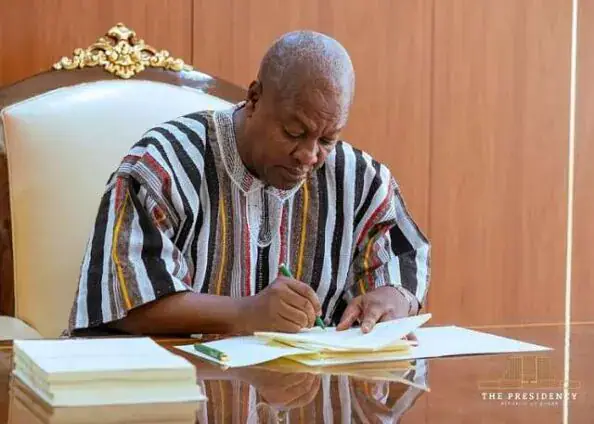
The Office of the President of Ghana has issued a directive requiring Chief Executives of public institutions and state-owned organisations who have exceeded the constitutional retirement limits to hand over and vacate office. This move is aimed at ensuring compliance with Article 199 of the 1992 Constitution, which sets the compulsory retirement age for public officers at 60. The directive was conveyed in a letter dated November 23, 2026, signed by Dr Callistus Mahama, Secretary to the President.
The directive instructs Ministers of State to ensure that CEOs under their oversight comply with the constitutional retirement age. Affected chief executives are required to submit their handing-over notes to their respective Boards or Councils without delay. The handing-over notes should outline ongoing programmes, outstanding decisions and commitments, and issues requiring immediate attention. This measure targets CEOs who have attained the age of 60 without a valid post-retirement contract or have exhausted the maximum period permitted for re-engagement.
According to Article 199(4) of the Constitution, an appointing authority can re-engage a retired public officer where the needs of the service require it. Such engagements can be granted for periods of up to two years at a time, but must not exceed five years cumulatively. Where re-engagement begins at age 60, the maximum period would end at age 65. The directive clarifies that chief executives who have reached the applicable limits should complete the handover process and leave office.
The directive places responsibility on ministers to ensure that institutions under their supervision comply with the constitutional requirements. Those approaching the end of their lawful tenure must submit their handing-over notes by their final day in office. This measure aims to ensure a smooth transition and continuity in the operations of public institutions and state-owned organisations.
The Presidency's move is aimed at upholding the constitutional provisions regarding the retirement of public officers. By enforcing the retirement limits, the government seeks to create opportunities for younger personnel to take up leadership roles and inject fresh perspectives into the public service. The directive is also expected to promote accountability and transparency in the management of public institutions.
The directive has implications for CEOs who have been serving beyond the retirement age or have had their contracts expire. Affected CEOs are expected to hand over their responsibilities to their successors or the relevant Boards or Councils. The government has emphasised the importance of compliance with the constitutional provisions to ensure the effective functioning of public institutions.
The implementation of the directive is expected to be monitored by the Office of the President, with ministers playing a crucial role in ensuring compliance within their respective portfolios. The move is part of efforts to promote good governance and adherence to the rule of law in Ghana's public sector. The directive is also seen as a step towards strengthening the country's institutional framework and promoting sustainable development.
Key points
- The directive requires state CEOs to retire at 60, in line with Ghana's constitutional limits.
- Affected CEOs must submit handing-over notes to their respective Boards or Councils.
- The move aims to promote accountability, transparency, and good governance in Ghana's public sector.
Reporting sources
- Mahama enforces retirement limit for state CEOs · todaygh.com