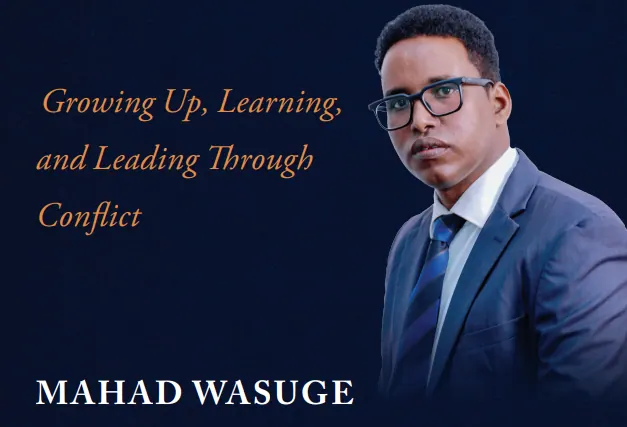
Mahad Wasuge's memoir, "Chaos, Courage and Change in Somalia: Growing Up, Learning and Leading Through Conflict," provides a unique perspective on Somalia's history through the eyes of a child trying to remain in school while the world around him came apart. Born in 1988 in Buulaburde, Somalia, Wasuge's story is one of resilience and determination in the face of conflict and hardship. His experiences, though personal, are relatable to many Somalis who grew up during the civil war.
Wasuge's journey began in Buulaburde, where he entered childhood just before the collapse of the central government. His recollections of home are intertwined with clan conflict, displacement, and insecurity. He describes violence and destruction in his town, alongside periods when his family sought safety in villages elsewhere in the region. These passages bring the consequences of conflict close to the reader, highlighting the impact on everyday life.
The death of Wasuge's father when he was twelve added a profound personal loss to an already difficult childhood. His mother assumed the responsibility of sustaining the family, first selling secondhand clothes and later opening a small shop in Buulaburde. Wasuge helped his mother while continuing his education, with school fees remaining a persistent concern. Her contribution gives the memoir a strong human foundation, highlighting the often-overlooked role of family members in an individual's perseverance.
Education provided continuity in Wasuge's life, repeatedly disrupted by conflict and hardship. He pursued Qur'anic and Islamic studies alongside formal schooling and opportunities to learn English. His description of private schooling in Buulaburde is revealing, showing that even modest educational opportunities can have a significant impact. Wasuge's account reminds readers that the importance of an educational opportunity cannot always be measured by the size or reputation of the institution providing it.
Wasuge's educational journey was far from straightforward, with fighting interrupting his primary education and financial hardship narrowing his options. After completing primary school, he hoped to continue his studies in Mogadishu, but the unexpected death of a relative with whom he was supposed to stay brought that plan to an end. With his mother's support, he found another route and moved to Beletweyne, where he continued his education despite ongoing uncertainty.
Wasuge's learning extended beyond academic institutions, with volunteer journalism, teaching, blogging, and research giving him opportunities to develop a public voice and acquire practical experience. His reflections on the Heritage Institute for Policy Studies are especially engaging, combining gratitude with disappointment. He credits the institute with opportunities to learn through practice and with support for his further education, including an online master's course at a university in London.
Through his journey, Wasuge shows what it meant to grow up without dependable institutions and how someone shaped by their absence came to build an institution of his own. His story, and that of his mother, gives the memoir a strong human foundation. The book offers a portrait of a generation, with many Somalis who grew up during the civil war recognizing its circumstances. Wasuge's experiences, though personal, are relatable and offer a unique perspective on Somalia's history.
Key points
- Mahad Wasuge's memoir provides an intimate perspective on growing up in Somalia during the civil war.
- The book highlights the impact of conflict on everyday life, particularly on education and family.
- Wasuge's journey shows resilience and determination in the face of hardship, and his story offers a unique perspective on Somalia's history.