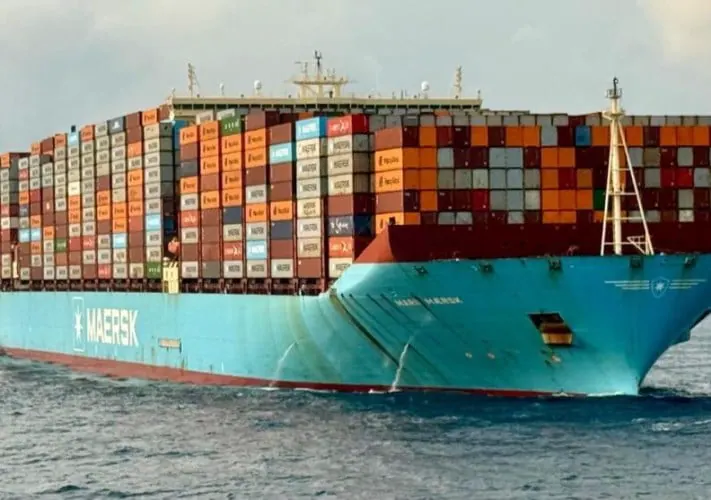
Maersk has announced plans to restructure its service network between Europe and West Africa, effective October 2026. The revamped network aims to enhance connectivity and reliability by including additional port coverage in Port Said, Lomé, and Pointe-Noire. The new structure will reorganize trade lanes through key hubs in West and Central Africa. This change is expected to improve the overall efficiency of Maersk's services in the region.
The revised network will feature several new services, including WAF 2, WAF 3, WAF 6, WAF 7, WAF 9B/C, WAF 10, and WAF 12. These services will connect major ports in Europe to key destinations in West and Central Africa. For instance, the WAF 2 service will link Algeciras, Tangier, and Dakar, while the WAF 3 service will connect Port Said, Algeciras, Tangier, Lomé, Abidjan, Tema, and Accra.
Maersk has also reconfigured its European cargo services to focus on direct connections through Abidjan, Lomé, Pointe-Noire, and Tema. This reorganization is expected to impact shipping routes from Europe to various destinations in West and Central Africa. By streamlining its services, Maersk aims to provide more efficient and reliable transportation solutions for its customers.
In addition to its European-West African network restructuring, Maersk has launched an expanded shuttle service along the West Coast of the Americas. This new service will connect Mexico, Panama, and Ecuador, providing broader port coverage, improved connectivity, and greater flexibility. The expanded shuttle service will replace the current single-vessel operation between Balboa and Boussurja.
The new shuttle service will be operated by three vessels, with the AS PALINA scheduled to commence its maiden voyage on September 20, 2026. The service will offer direct connections from Mexican ports Lázaro Cárdenas and Manzanillo to the Ecuadorian port of Boussurja. This is expected to provide faster transportation options for cargo originating from Asia.
Maersk will also transfer its feeder service for the port of Guayaquil to the expanded shuttle service. This move will ensure continued access to the Ecuadorian market through the new network. By enhancing its services in the region, Maersk aims to strengthen its presence in the West Coast of the Americas.
Furthermore, Maersk has announced plans to implement a Peak Season Surcharge (PSS) on container shipments from South America's East Coast to various European markets. The PSS will take effect on November 1, 2026, and will apply to shipments from Brazil, Argentina, Uruguay, and Paraguay to North Europe, Central and East Europe, the East and West Mediterranean, Scandinavia, the Baltics, and the Black Sea.
Key points
- Maersk's network restructuring aims to improve connectivity and reliability between Europe and West Africa.
- The company has launched an expanded shuttle service along the West Coast of the Americas.
- Maersk will implement a Peak Season Surcharge on container shipments from South America's East Coast to Europe.