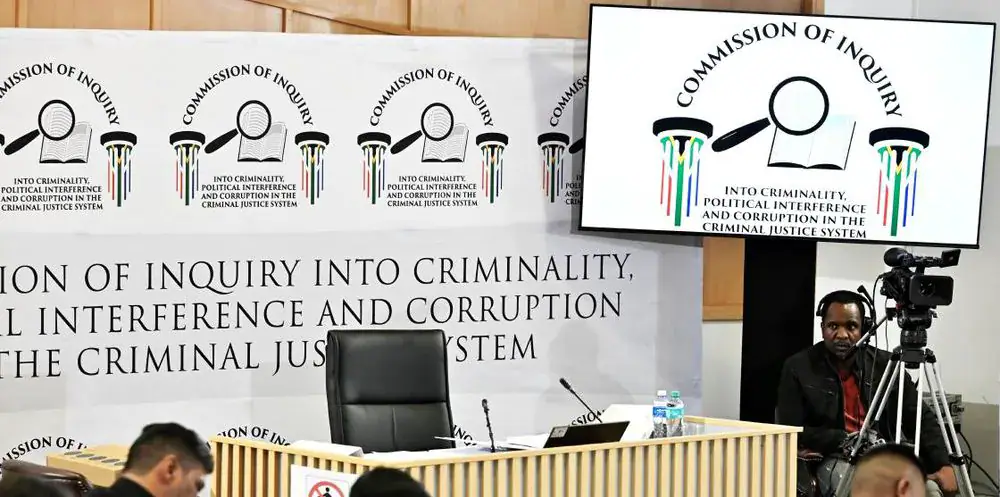
The Madlanga Commission, established in July 2025 following allegations by KZN Provincial Police Commissioner Lieutenant-General Nhlanhla Mkhwanazi, has uncovered serious systemic weaknesses in South Africa's criminal justice system. The commission's findings have sparked urgent calls for reform, with leading authorities emphasizing the need for transparent hiring, rigorous oversight, and structured reforms to address corruption and organised crime. The commission's revelations have laid bare vulnerabilities across the criminal justice system, underscoring the need for immediate action.
Police Minister's advisor, Advocate Vusi Pikoli, has stressed that the current moment presents an opportunity to transform not just the police but the entire criminal justice system. Pikoli emphasized that the system must be anchored in the values enshrined in the Constitution, with a focus on transparent, competitive recruitment and rigorous vetting processes. He noted that the process of transformation has never been completed and that fundamental issues, including recruitment, need to be addressed. Pikoli called for an open and transparent recruitment process, accompanied by modern, streamlined vetting.
National Prosecuting Authority of South Africa (NPA) Deputy National Director of Public Prosecutions (NDPP) Advocate Chuma Mtengwane acknowledged that the system faces integration challenges but sees the Madlanga Commission as an opportunity to strengthen the entire criminal justice system value chain. Mtengwane highlighted severe institutional vulnerabilities, interference risks, and compromised information flows across the police and criminal justice system. She emphasized the need for immediate operational learning, institutional integrity, lifestyle audits, and thorough financial disclosures.
Business Against Crime South Africa CEO Advocate Anton du Plessis noted that the current situation represents a more dangerous form of state capture driven by the conflation of corruption and organised criminality. Unlike the corruption-focused Zondo commission, du Plessis emphasized that the Madlanga Commission's findings demand structural, evidence-led reforms. He suggested implementing regular, targeted lifestyle audits and establishing holistic, prosecution-guided investigations to address system integrity and fragmentation.
The Madlanga Commission's findings have highlighted serious allegations extending beyond traditional procurement corruption into systemic infiltration by organised crime. The commission's recommendations include criminal prosecution, disciplinary measures, and institutional reform. Speakers at an event hosted by the Institute for Security Studies (ISS) emphasized that corruption and organised crime have exposed vulnerabilities across the criminal justice system, underscoring the urgent need for reform.
Key stakeholders, including Pikoli, Mtengwane, and du Plessis, have emphasized the need for a sequenced and evidenced approach to reform. They stress that reforms must be intentional, evidence-led, and implemented against the realities faced by the criminal justice system. The stakeholders also highlighted the importance of addressing system integrity and fragmentation without overcomplicating the process.
The Madlanga Commission's revelations have sparked a renewed focus on criminal justice reform in South Africa. With the commission's findings highlighting systemic weaknesses and vulnerabilities, stakeholders are calling for urgent action to address these challenges. The implementation of structural reforms, evidence-led and sequenced, is seen as critical to strengthening the criminal justice system and addressing the threats posed by corruption and organised crime.
Key points
- The Madlanga Commission's findings highlight the need for transparent hiring, rigorous oversight, and structured reforms in South Africa's criminal justice system.
- Stakeholders are calling for a sequenced and evidenced approach to reform, with a focus on addressing system integrity and fragmentation.
- The implementation of structural reforms, evidence-led and sequenced, is seen as critical to strengthening the criminal justice system.