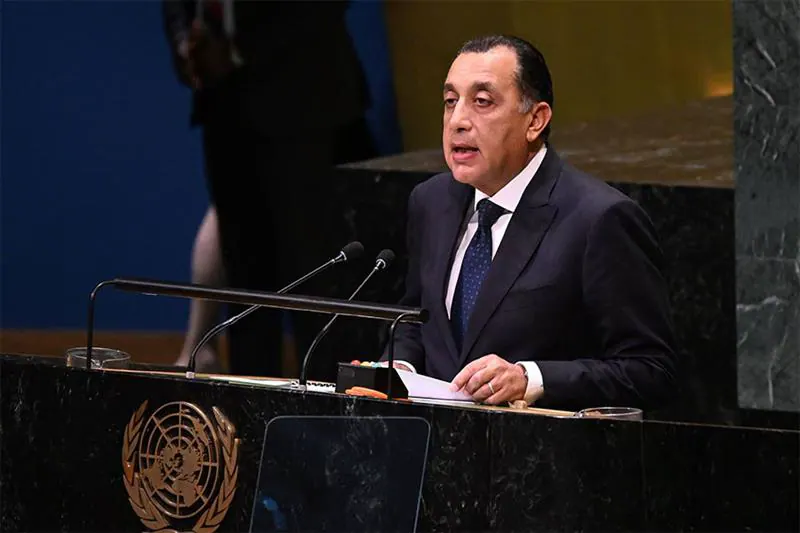
Prime Minister Mostafa Madbouly’s address at the United Nations General Assembly reflected a comprehensive Egyptian vision for addressing global transformations and crises. Ambassador Dr. Mohamed Hegazy stated that Madbouly’s speech combined the defence of Egypt’s national interests with a broader call to reform global governance and restore confidence in multilateralism. Hegazy highlighted that the address emphasized the importance of effective multilateralism based on fairer representation and decision-making. This approach aims to promote greater equity in access to development opportunities and the benefits of global transformation.
Hegazy noted that the central message of Madbouly’s address was that the crisis facing the international system stems not from an absence of charters or principles, but from the widening gap between proclaimed commitments and their implementation. Egypt called for equal application of international law and greater equity in access to development opportunities. The address also highlighted the Palestinian issue as a crucial test of the international system’s credibility. Egypt emphasized the need for an immediate ceasefire in Gaza and the establishment of an independent Palestinian state.
Madbouly’s address also underscored that Egypt’s water security is an existential issue, allowing no compromise. Egypt reaffirmed its support for the right of other peoples to development, provided that development does not come at the expense of Egypt’s rights and interests. Hegazy stated that this approach combines the defence of Egypt’s national security with a continued commitment to cooperation and dialogue. Egypt’s message on water security was clear and unequivocal, emphasizing the importance of adhering to international law.
On Sudan, Hegazy stated that Egypt continues to support the Sudanese people, the unity and sovereignty of the Sudanese state, and the preservation of its national institutions. Egypt believes that Sudan’s stability is a direct interest of regional security. Ending the war in Sudan requires a political solution that preserves the state and brings an end to the humanitarian suffering of the Sudanese people. Egypt’s position on Sudan reflects its commitment to regional stability and security.
Hegazy also highlighted Egypt’s call for reform of the UN Security Council to ensure more equitable representation of Africa and developing countries. This call acquires particular importance amid profound changes in the global distribution of power, population, and economic weight. Reforming the international political system cannot be separated from reforming the global financial architecture to provide developing countries with greater access to development finance.
The address also incorporated artificial intelligence within Egypt’s wider vision, reflecting an important shift from responding to present crises to participating in shaping the rules of the future. Egypt called for the ethical and equitable governance of AI, alongside greater knowledge transfer and capacity-building for developing countries. This approach aims to prevent the digital divide from evolving into a new divide in power, wealth, and influence.
Hegazy concluded that Egypt’s address was comprehensive, well-informed, and substantive, presenting a balanced vision based on realistic solutions. The address aimed at promoting security and stability through adherence to international law while reaffirming the principles of multilateralism, justice, and equity. The speech raised fundamental questions about how the world can move from managing crises to addressing their underlying causes and from formal multilateralism to genuinely effective multilateralism.
Key points
- Egypt's Prime Minister Mostafa Madbouly emphasized the need for effective multilateralism and global reform in his address to the UN General Assembly.
- The address highlighted Egypt's priorities, including the Palestinian issue, water security, and Sudan's stability.
- Egypt called for reform of the UN Security Council and the global financial architecture to ensure more equitable representation and access to development finance.