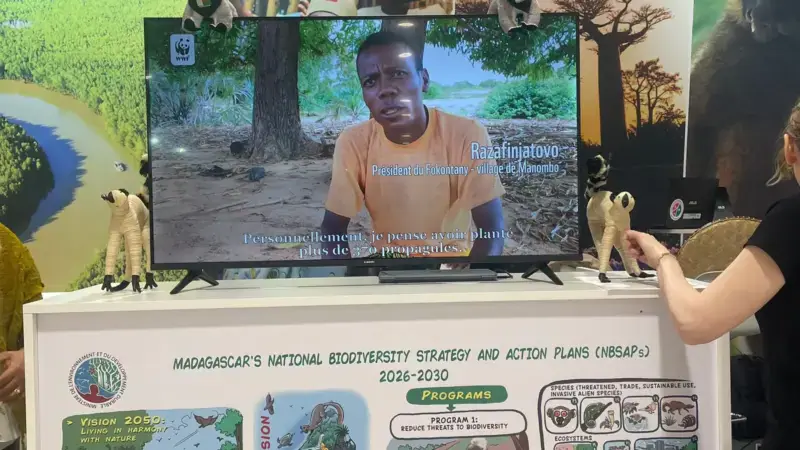
Madagascar has reaffirmed its commitment to protecting its remarkable biodiversity at the 17th Conference of the Parties (COP17) on biological diversity, held in Yerevan, Armenia, from October 19-30, 2026. The country showcased techniques implemented by local community members and outlined its plans and priorities for protecting terrestrial and marine ecosystems. This conference provided an opportunity for Madagascar to strengthen green partnerships, develop new collaborations, and engage with national and international stakeholders involved in biodiversity conservation.
Tojotsara Ratefason, Director of the Directorate of Protected Areas, Renewable Natural Resources, and Ecosystems (DAPRNRE), part of the Madagascan government's Ministry of Environment and Sustainable Development (MEDD), was interviewed by Global Voices at COP17. The interview focused on Madagascar's role in implementing the Kunming-Montreal Global Biodiversity Framework, the 30×30 global target, conservation funding, and the vital role of local communities, women, and young people in sustainable protection of Madagascar's natural heritage.
Madagascar is confident in its ability to contribute to the 30×30 global target for both terrestrial and marine ecosystems. The country has an existing system of protected areas, which comprises 155 terrestrial and marine protected areas. This network is a significant foundation for preserving Madagascar's exceptional biodiversity. The country has a national reference framework, the Stratégie et le Plan d'Actions Nationaux pour la Biodiversité (SPANB), which defines the country's conservation, sustainable use, and valorization of its natural heritage.
The protection of biodiversity in Madagascar goes beyond the number of protected areas and their size. The country's objective is to preserve ecosystems, species, and natural habitats that make Madagascar unique. Madagascar's natural heritage is exceptional, and the country has a responsibility to pass it on to future generations. This ambition involves strengthening collaboration with local communities, who play a vital role in conservation efforts.
Local communities, women, and young people are essential partners in the sustainable protection of Madagascar's natural heritage. The country recognizes the importance of involving these stakeholders in conservation efforts and promoting their initiatives. By working together, Madagascar aims to ensure the long-term protection of its biodiversity and natural resources.
Conservation funding is a significant challenge for Madagascar, and the country is exploring ways to address this issue. The government is seeking to develop new partnerships and collaborations to support conservation efforts. Additionally, Madagascar is promoting initiatives that involve local communities and provide economic benefits, such as sustainable tourism and eco-friendly activities.
Madagascar's commitment to biodiversity protection is reflected in its participation in international agreements, such as the Convention on Biological Diversity. The country is dedicated to translating its international commitments into national actions and is working to implement the Kunming-Montreal Global Biodiversity Framework. By protecting its natural heritage, Madagascar aims to preserve its unique biodiversity and ecosystems for future generations.
Key points
- Madagascar has 155 protected areas, including terrestrial and marine ecosystems, which form a crucial foundation for preserving its exceptional biodiversity.
Reporting sources
- Madagascar aims to support biodiversity by protecting marine areas · Global Voices Africa