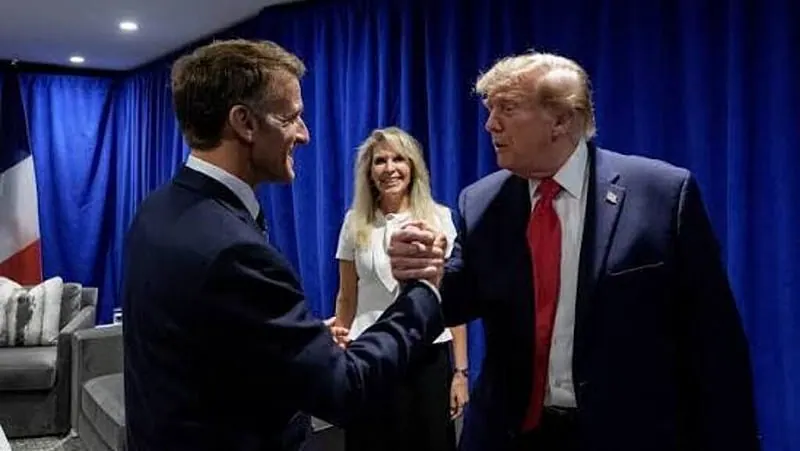
French President Emmanuel Macron held talks with US President Donald Trump on September 21, 2026, in New York, ahead of the United Nations General Assembly. The two leaders discussed ways to ease pressure on global energy markets, including reopening the Strait of Hormuz and a possible energy truce between Russia and Ukraine. Macron described their discussion as "very constructive". The talks came as oil prices surged due to disruptions in the Strait of Hormuz, a critical waterway for global oil and gas trade.
The Strait of Hormuz, which connects Iran and Oman, normally handles around 20 percent of the world's commercial oil and gas trade. Its closure, resulting from the ongoing conflict involving Iran, Israel, and the US, has significantly impacted global energy prices. Macron stated that several solutions were discussed to allow container ships and tankers to pass through the strait without a comprehensive agreement. A French diplomatic source revealed that Paris is working on a UN Security Council resolution to guarantee freedom of navigation through the strait.
According to the French diplomatic source, a UN Security Council resolution could enable member states to help secure maritime traffic in the Strait of Hormuz. This would allow Washington and Tehran to focus on other disputes, including Iran's nuclear program. France and the UK have already established a multinational initiative involving around 40 countries to secure the strait, including mine clearance. However, the initiative's success depends on a ceasefire and has garnered little interest from Trump.
Macron also discussed Ukraine with Trump, emphasizing the need for faster and larger deliveries of air defense interceptor missiles to Kyiv. Macron had lengthy discussions with Trump on providing "even faster and more substantial assistance" to Ukraine in terms of interceptors. He also raised the prospect of an "energy truce and a moratorium in the Black Sea" with Trump. This initiative aims to help Ukraine's energy system and address the situation in the region.
Ukraine's energy infrastructure has faced significant challenges due to the ongoing conflict with Russia. Macron's proposal for an energy truce and moratorium in the Black Sea could help alleviate some of the pressure. However, it is unclear whether such a truce would require Ukraine to halt strikes on Russian energy infrastructure. Trump previously stated that Russia had "lost control of its diesel industry" due to the war with Ukraine.
Turkey has presented proposals to Kyiv and Moscow aimed at ending strikes on merchant vessels in the Black Sea. The proposals come amid increasing concerns about attacks in the region. France and other European countries are seeking to ensure continued US support for Kyiv while increasing pressure on Moscow. They also want to remain closely involved in any negotiations over a settlement, particularly those concerning Ukraine's long-term security.
The international community is closely watching developments in Ukraine and the Strait of Hormuz. Macron's talks with Trump highlighted the need for coordinated efforts to address these pressing issues. The two leaders' discussions demonstrated a shared commitment to finding solutions to ease pressure on global energy markets. However, concrete breakthroughs remain elusive, and successive rounds of talks have yet to produce tangible results.
Key points
- Macron and Trump discussed measures to reopen the Strait of Hormuz and establish an energy truce between Russia and Ukraine.
- France is working on a UN Security Council resolution to guarantee freedom of navigation through the Strait of Hormuz.
- Macron emphasized the need for faster and larger deliveries of air defense interceptor missiles to Kyiv.