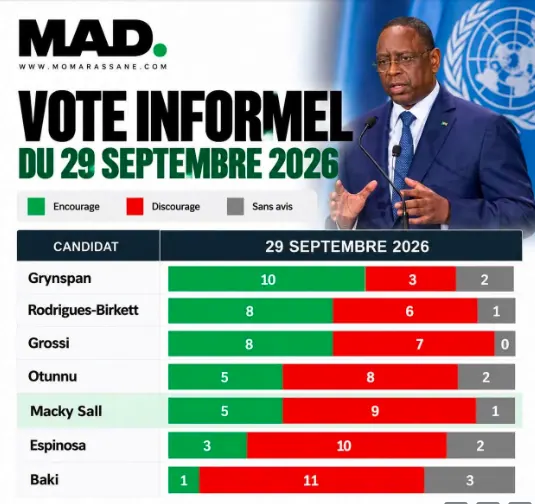
The race to succeed Antonio Guterres as UN Secretary-General has taken a significant turn, with Senegal's former President Macky Sall facing a serious setback. On September 29, 2026, the UN Security Council held its fourth indicative vote, and Sall received only 5 "encouragement" votes, while 9 votes were cast to "discourage" his candidacy, with 1 abstention. This result leaves Sall trailing behind other candidates. According to Télé Futurs Médias, Sall's bid is now in a precarious position.
In contrast, Rebeca Grynspan, the former Vice-President of Costa Rica and ex-head of the UN Conference on Trade and Development (UNCTAD), has strengthened her position as a frontrunner. She secured 10 votes in favor, 3 against, and 2 abstentions, surpassing the symbolic threshold of 9 votes required for formal validation. Grynspan's momentum is building, and she is now considered the favorite to succeed Guterres.
The rest of the field is closely contested, with several candidates vying for position. Carolyn Rodrigues-Birkett, the former Foreign Minister of Guyana, secured 8 votes in favor, 6 against, and 1 abstention, placing her second. Rafael Grossi, the current Director of the International Atomic Energy Agency (IAEA), received 8 encouragement votes, 7 discouragement votes, and no abstentions. Olara Otunnu, a Ugandan diplomat, marginally edged out Sall with a score of 5-8-2.
Despite Grynspan's strong showing, her victory is not yet assured. The anonymous nature of the indicative votes makes it difficult to determine if her 3 discouragement votes represent a veto from one of the 5 permanent members of the Security Council (United States, Russia, China, France, and the United Kingdom). A single veto from any of these countries could derail her bid.
For Sall, the outlook is increasingly bleak. Unless a significant diplomatic turnaround occurs in the coming rounds, it appears that Africa may struggle to secure the position of UN Secretary-General. The next rounds of voting will be crucial in determining the outcome of the election.
The UN Security Council's voting process is designed to ensure that the Secretary-General is elected through a broad consensus. The Council consists of 15 members, with 5 permanent members and 10 non-permanent members serving for 2-year terms. The election is expected to conclude in the coming weeks.
As the election enters its final stages, attention is focused on the remaining candidates. While Grynspan is currently in the lead, the dynamics of the election can shift rapidly. Macky Sall's bid may still be revived, but it will require significant diplomatic efforts to regain momentum.
Key points
- Rebeca Grynspan leads the field with 10 votes in favor, 3 against, and 2 abstentions.
- Macky Sall faces a significant setback with only 5 encouragement votes and 9 discouragement votes.
- The UN Security Council's voting process requires a broad consensus to elect the next Secretary-General.