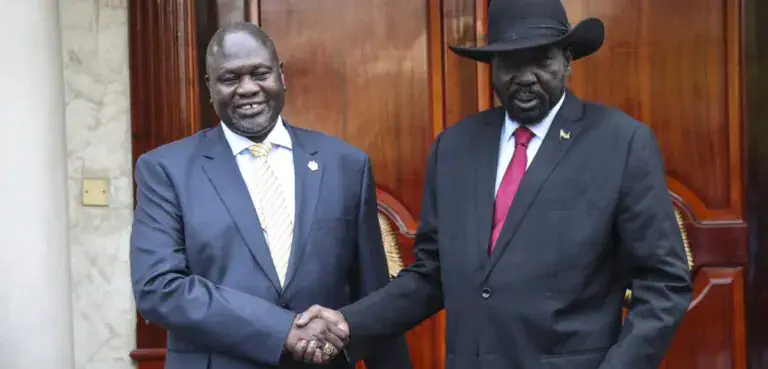
Former First Vice President Dr. Riek Machar testified in the special court in Juba that President Salva Kiir did not respond to his request for a two-week delay in deploying South Sudan People’s Defence Forces troops to Nasir. Machar said he wrote to Kiir on February 20, 2025, requesting the delay to allow local leaders to prepare residents for the troops’ arrival. The request was made amid rising tensions and fears among local residents.
Machar stated that he wanted to send members of parliament representing Nasir and Ulang counties to help calm the situation, but Kiir’s lack of response prevented him from doing so. Residents were concerned that the deploying forces were not the agreed Necessary Unified Forces, but rather exclusively from the South Sudan People’s Defence Forces. The change in composition alarmed communities in Nasir and surrounding areas, who feared they would be disarmed by the incoming troops.
According to Machar, residents in the two counties were particularly concerned about reports that the incoming troops included forces associated with Abushok and the Agwelek militias. This concern led Machar to request that members of the National Assembly representing Nasir and Ulang counties travel to their constituencies to address the situation. The deployment of troops to Nasir was initially intended to be part of the Necessary Unified Forces.
Machar also revealed that government officials worked to persuade youth in Nasir to abandon a reported plan to attack oil fields in the area. He contacted General Paul Nang within 24 hours to seek updates on preparations for the rotation of SSPDF troops in Nasir and whether Nang had met with General Gabriel Duop Lam. This effort was part of a broader attempt to manage tensions in the region.
Before Nang visited the two counties, authorities received information that youth had regrouped in Kuerenge and were pursuing another plan to attack oil fields. The United Nations Mission in South Sudan provided a helicopter from Malakal to transport a delegation to talk to the youth. The Minister of Petroleum played a key role in providing transport for those traveling from Juba to Nasir to join the delegation.
Machar’s testimony is part of the 129th session of the trial, during which he is presenting his defence statement. The court adjourned proceedings until Monday, November 23, when Machar is expected to continue testifying. His testimony highlights the complexities and challenges of implementing security arrangements in South Sudan.
The trial continues to shed light on the intricacies of South Sudan’s security situation and the efforts of its leaders to address these challenges. Machar’s testimony provides insight into the interactions between senior government officials and the impact of their decisions on local communities. The case will likely continue to have significant implications for the country’s ongoing peace process.
Key points
- President Salva Kiir did not respond to Machar’s request for a two-week delay in deploying troops to Nasir.
- Residents in Nasir and Ulang counties were concerned that the deploying forces were not the agreed Necessary Unified Forces.
- Government officials worked to persuade youth in Nasir to abandon a plan to attack oil fields in the area.